Memorize 197 flags in 1 week
Rules & Details
The goal
Memorize ~195 country flags on sight. Flag -> country name (one direction only) I'll be using Sporcle for the baseline & the final.
The rules
- AI is my coach. I must follow its plan daily.
- I document, journal & report daily to share to my audience but also to feed this data back to AI so it gives me feedback & updates my customized plan based on how well I'm learning & how I best learn. I'll be documenting here and on my Instagram so follow along!
- 60-90 minutes max daily. I'm a startup founder & have other things to do in my day. This also ensures that AI gives me the highest leverage tactics.
Why am I doing this challenge series?
I want to show how AI can help me AND your achieve your goals, no matter how big or small.
And personally, HONESTLY, I've attempted multiple times to do niche & ridiculously difficult challenges (I like a good challenge).
So I thought public humiliation could be a creative way to stay accountable! If this series flops, it's an asymmetric bet since I get to achieve the goals I want to achieve anyway!
Other things on my list (MAYBE they turn into series videos to, let's see!)
- Do 1 proper pull-up
- Do a front walk (I can't even do a cartwheel)
- Achieve perfect pitch
- Beat my husband at Smash or Chess
- Split (actually already did this last year!)
Btw, I'm also inspired by a blog by Max Deutsch who ran "Month to Master" almost 9 YEARS AGO now!
Why am I doing this specific flag challenge?
I like games & trivia. In most trivias, there is a flag component. I'd be honored to be the flag girl ⛳ (& actually contribute something meaningful!)
Why does AI have to feed into this?
Well, it's an AI channel, babe, so OF COURSE I have to incorporate AI!
More importantly, in the practice of developing expert skills, "deliberate practice" gets thrown around a lot and turns out...
Deliberate practice is most effective when conducted with some kind of coach who can give feedback, point out errors, suggest techniques for improvement, and provide vital motivation.
In the absence of a paid expert coach who I don't have budget to pay for, in the age of AI, I can learn FASTER & BETTER because instead AI is the coach that gives me the feedback I need to master a ridiculously challenging skill.
Am I working on this full time?
Nope! I'm a founder and creator. That's why I constrained the flag challenge to about 90m max daily. Maybe if I do future challenges, it increases depending on the scope. But point is I am doing this for just a couple hours a day. I hope to prove that’s all I’ll need.
Day 0: Baseline & Planning the Agent
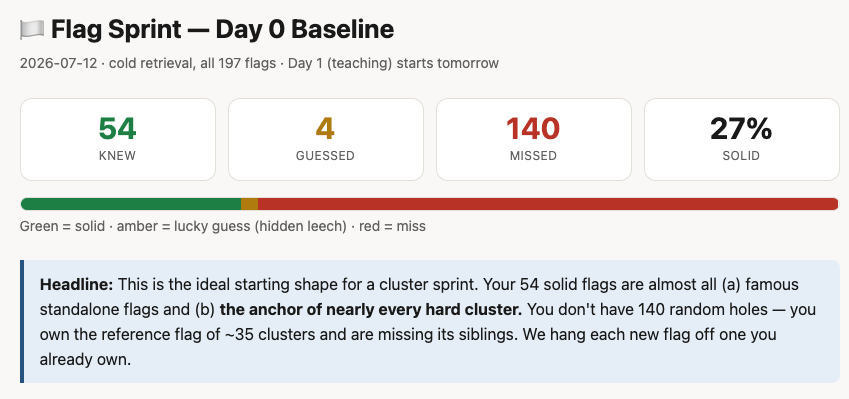
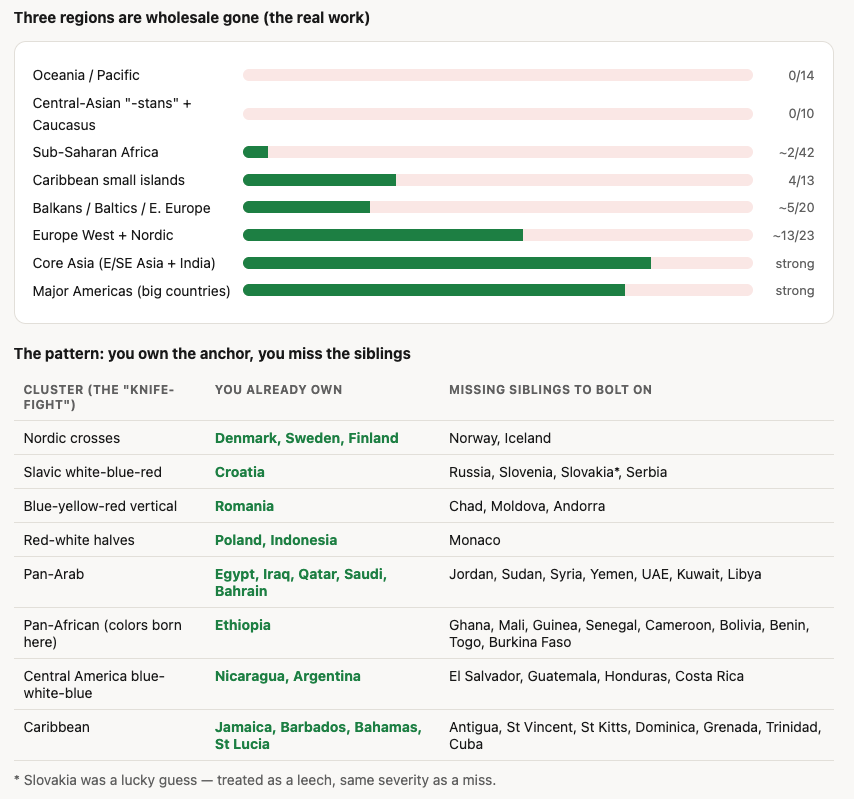
My baseline report
54/197 (about 27%)
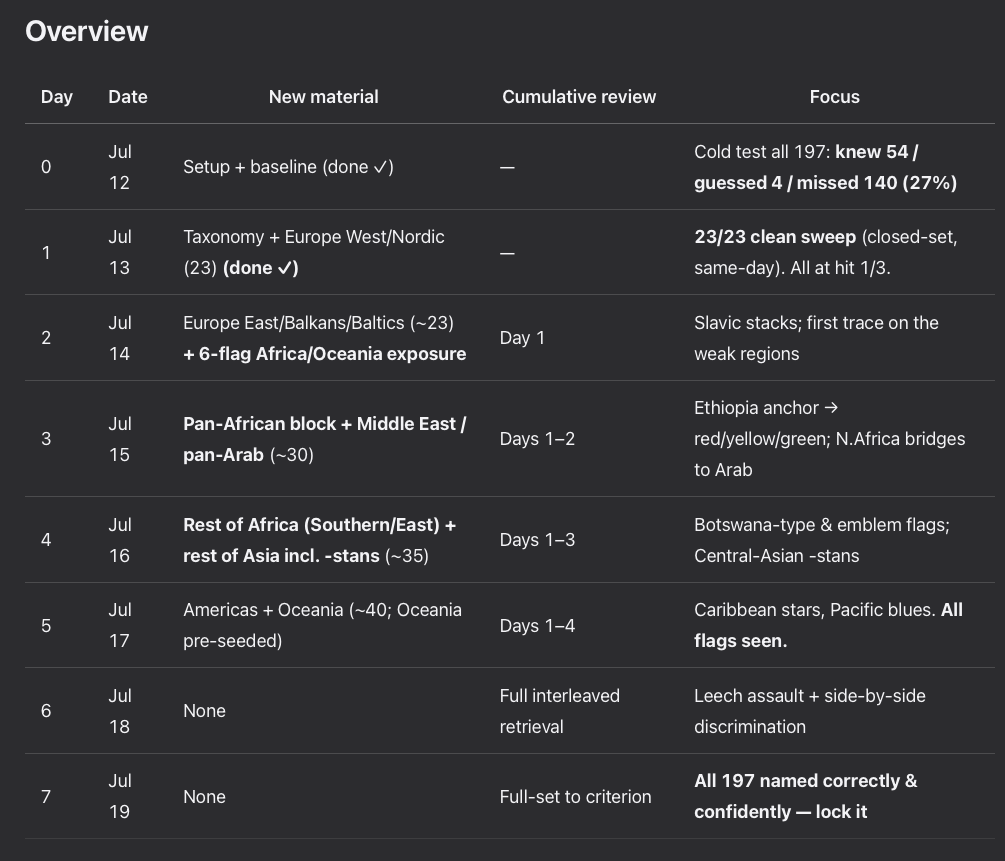
The weekly & daily plan
On day zero I took a cold test on all 195. I got 27% right 🥲 Everything was built around that (embarrassing) baseline number
Each day focuses on a "family" of flags e.g. European region, Oceania, Central Asian "-stans," most of Africa & frontloads the families I scored the worst in.
My daily ritual looks something like this:
- In the morning, I quiz myself cold first, before I re-study anything
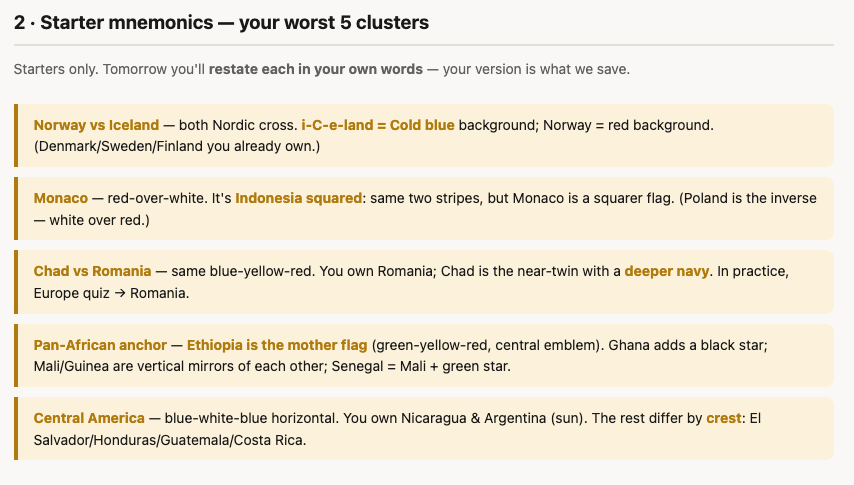
- Then I learn the new batch by "family". Claude gives me a memory mnemonic or hook for each one. If there are fun, new mnemonics that I find are more helpful, I ask Claude to log it to my mnenomics.md
- I then take a "quiz" based on the family that I learned for the day AND all the other flags I learned from previous days (so gets harder per day)
- I take a break then come back later at night and take the same quiz.
- I send my results back to the coach. It tells me what I got wrong, why, and rewrites tomorrow's plan accordingly!
How the agent is put together
It's Claude, running out of one project folder (flag-challenge agent).
~/flag-challenge/
├── AGENTS.md            # my operating instructions as coach — the brain of the whole system
├── CLAUDE.md            # → @AGENTS.md (so Claude Code + any other agent read the same rules)
├── plan.md              # the living 7-day plan; I rewrite it every night from your results
├── leeches.md           # your active leech list + confusable pairs, with miss counts
├── mnemonics.md         # the growing mnemonic library, saved in your own words
├── log/
│   └── day-N.md         # daily state I append at session close (score, predicted-vs-actual,
│                        #   new leeches, retired flags, pace) — this is what a fresh thread
│                        #   reads each morning to rebuild where I left off
├── reports/
│   └── day-N.html       # the 4-section HTML report I output each day (diagnosis, mnemonics,
│                        #   micro-review schedule, plan changes)
└── drill/
    ├── quiz.html        # the local flag quiz — real images, shuffled, confidence buttons,
    │                    #   leech-weighted, no timer (accuracy over speed)
    ├── study-dayN.html  # the "just follow this" study sheet I generate when you say "Day X":
    │                    #   ordered steps + flags shown as images, grouped by visual family
    └── flags/           # 196 flag images stored locally, so everything works offline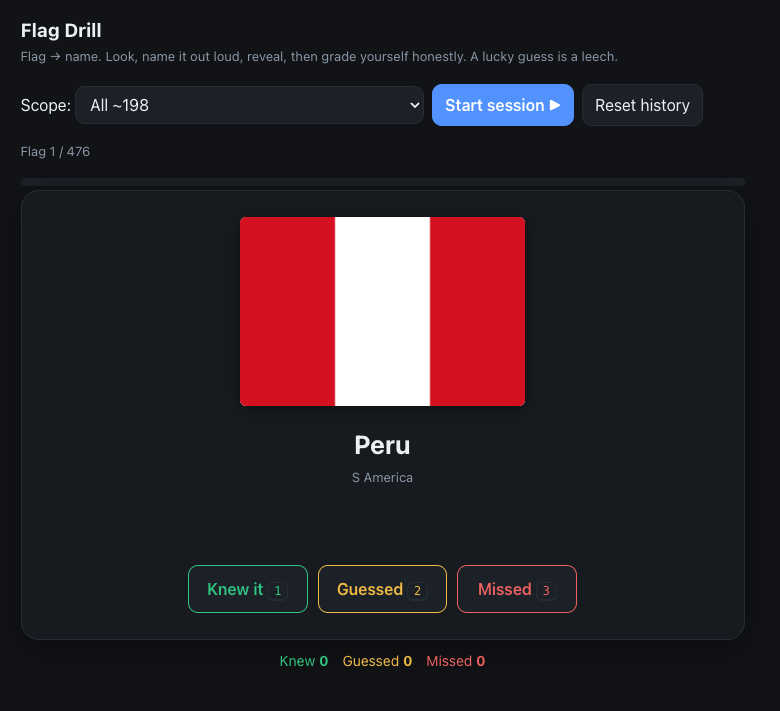
The memory principles
- Testing beats reading. That's why I quiz myself 2x daily
- Drilling! Especially for flags that I keep forgetting!
- Look-alikes are clustered & studied together so I can tell the differences.
- Mnemonics are mine. Specific, pretty ridiculous, so it's memorable
- Little and often, with sleep in between. Short daily reps > one long cram
My prompt
In case you want to copy it for yourself. I had a simpler starting prompt, it built a whole agent out based on my goals and I got started in under 1 hour! This prompt below is a reverse-engineered version of my current setup.
You are the best memory athlete & my flag-learning coach for a 7-day challenge to recognize all ~195 country flags on sight. I have NO human tutor — you are my only coach. Draw principles from the best memory athletes.

Give me a preliminary day to day plan that I can follow to achieve this, based on the best memory learning principles.

Your job each day:
- Plan the session and tell me exactly what to do
- Teach vivid mnemonics for flags that look alike and for all flags so they stick
- Quiz me and track my misses
- Diagnose WHY I'm failing (which pairs I confuse, which regions are weak). Help me run a consistent diagnostic "test" to do this daily.
- Rewrite tomorrow's plan based on my daily report

Rules:
- Primary skill = flag → name (I see a flag, I name the country)
- Spaced repetition: resurface my misses more often than flags I've nailed.
- When I confuse two flags, give me ONE vivid, specific way to tell them apart.
- After each daily report, output exactly: (1) diagnosis of my error patterns,
  (2) new/updated mnemonics for my worst 3–5 confusions, (3) today's spaced micro-review
  schedule, (4) any change to tomorrow's plan. Output this into an HTML file
- Keep me honest on pace. If I'm behind, tell me what to cut.

Tell me what other rules, daily rituals and things I should be doing based on memory and learning principles that I haven't incorporated in the plan above.

Give me the proposed plan for how to setup an agent for this flag-learning coach.

Start with the plan and setup first and then let's go from there.
See you tomorrow for Day 1!!!
Day 1: Strong start
My study plan for the day
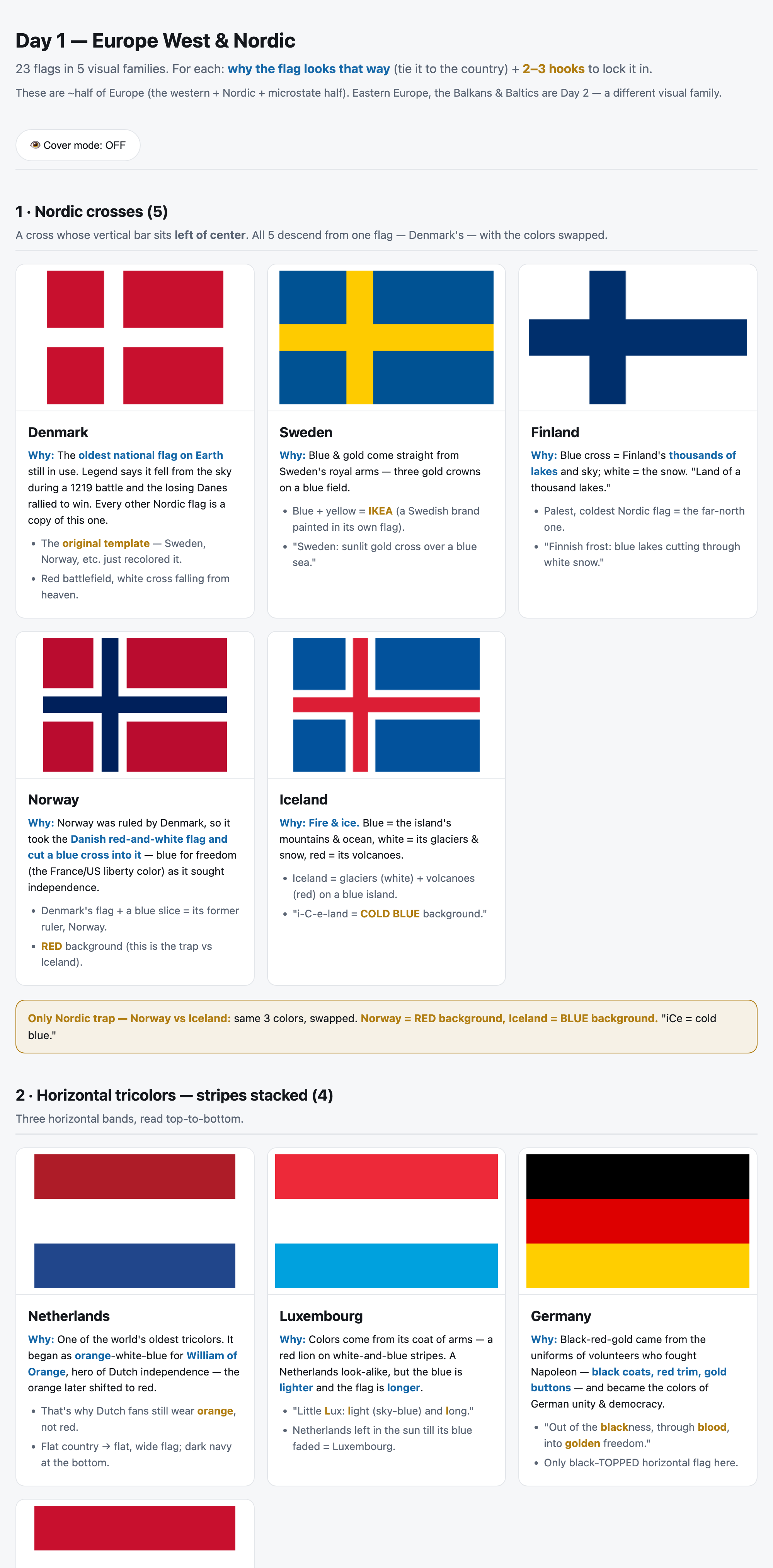
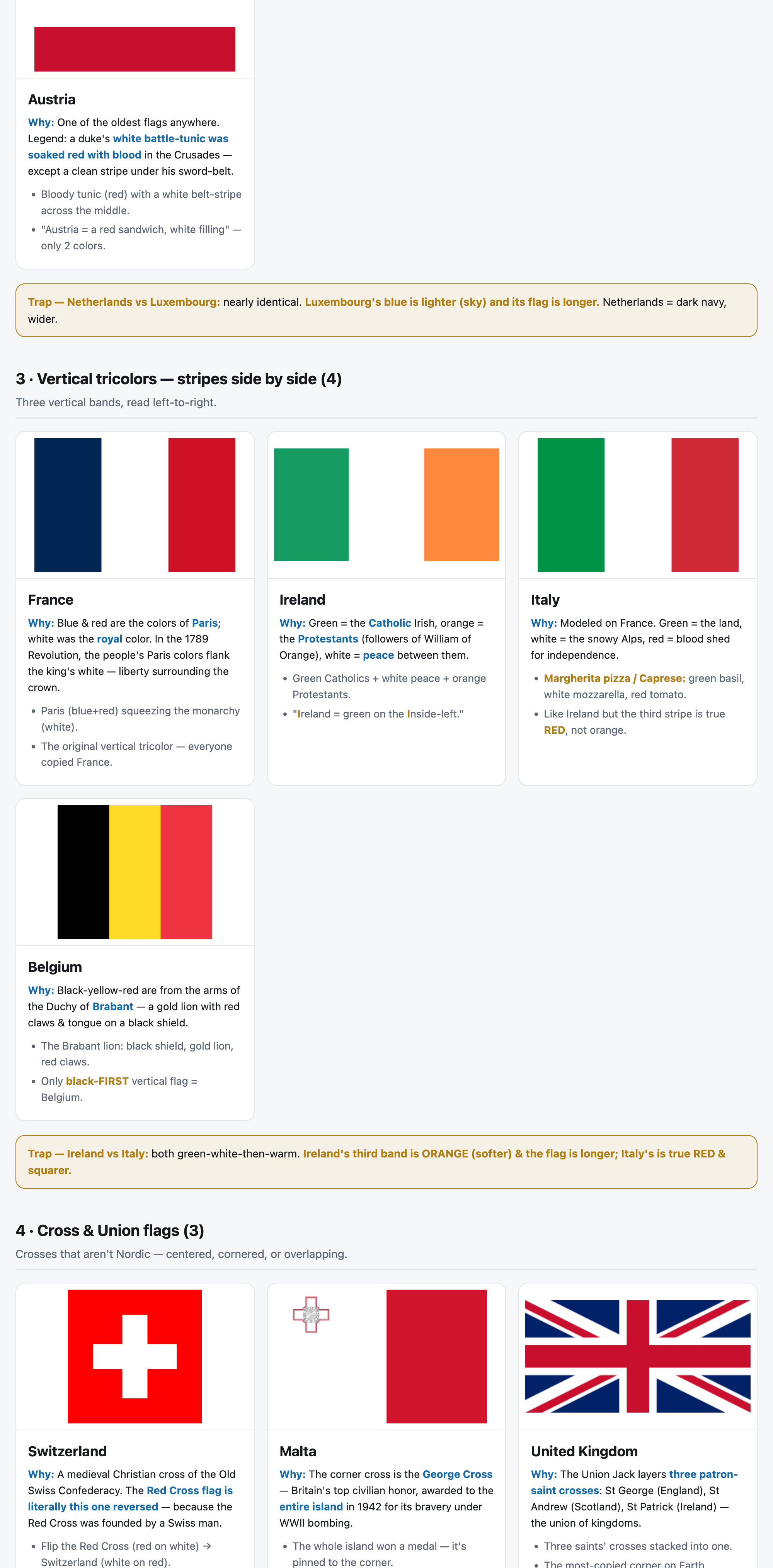
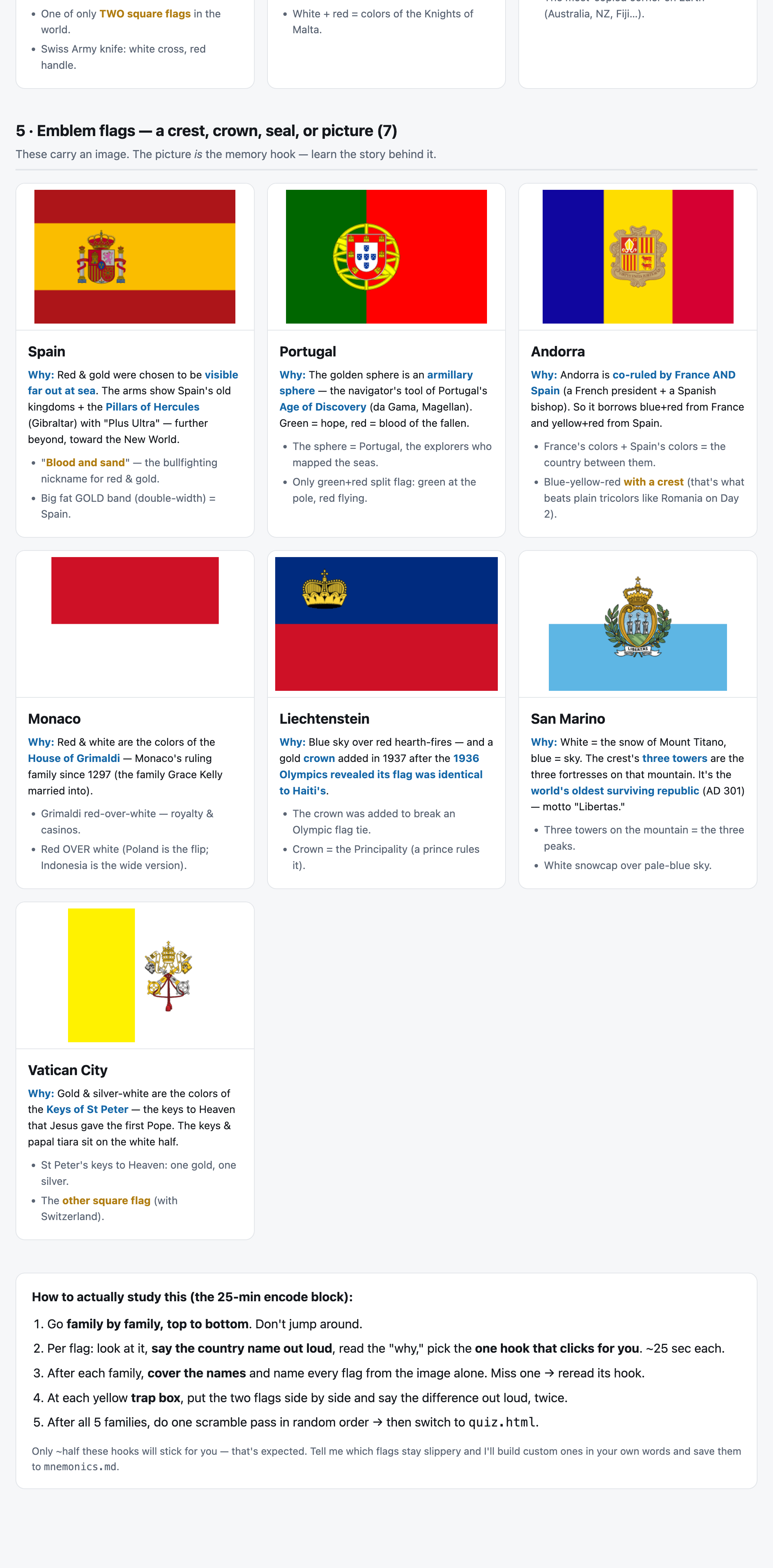
- Learn the "grammar" first (~10 min). I read through each family & "shape of flag": Nordic crosses (the off-center cross of Iceland, Norway, Sweden, Finland, Denmark), vertical tricolors, horizontal tricolors, the micro-states.
- Encode the 23 by family (~25 min). I went down each flag from Western Europe and the Nordics, grouped by shape, never alphabetically, and attached a mnemonic to each.
- Discrimination drills on the built-in traps (~15 min):
- Norway vs Iceland (same cross, colors inverted: red background or blue?)
- Netherlands vs Luxembourg (Luxembourg's blue is lighter, its stripes taller)
- Ireland vs Italy (green-white-orange vs green-white-red)
- Interleaved quiz in the drill tool (~15 min).
- 30-flag diagnostic to close (~10 min).
(TBH these time ranges were quite innacurate. I maybe spent most time on the mnemonics and the rest took 1-5min.)
How I did
One test today, under the easiest possible conditions:
- Day 1 quiz (closed set, same-day): 23 knew, 0 guessed, 0 missed — 23/23. Boom, baby, easy!
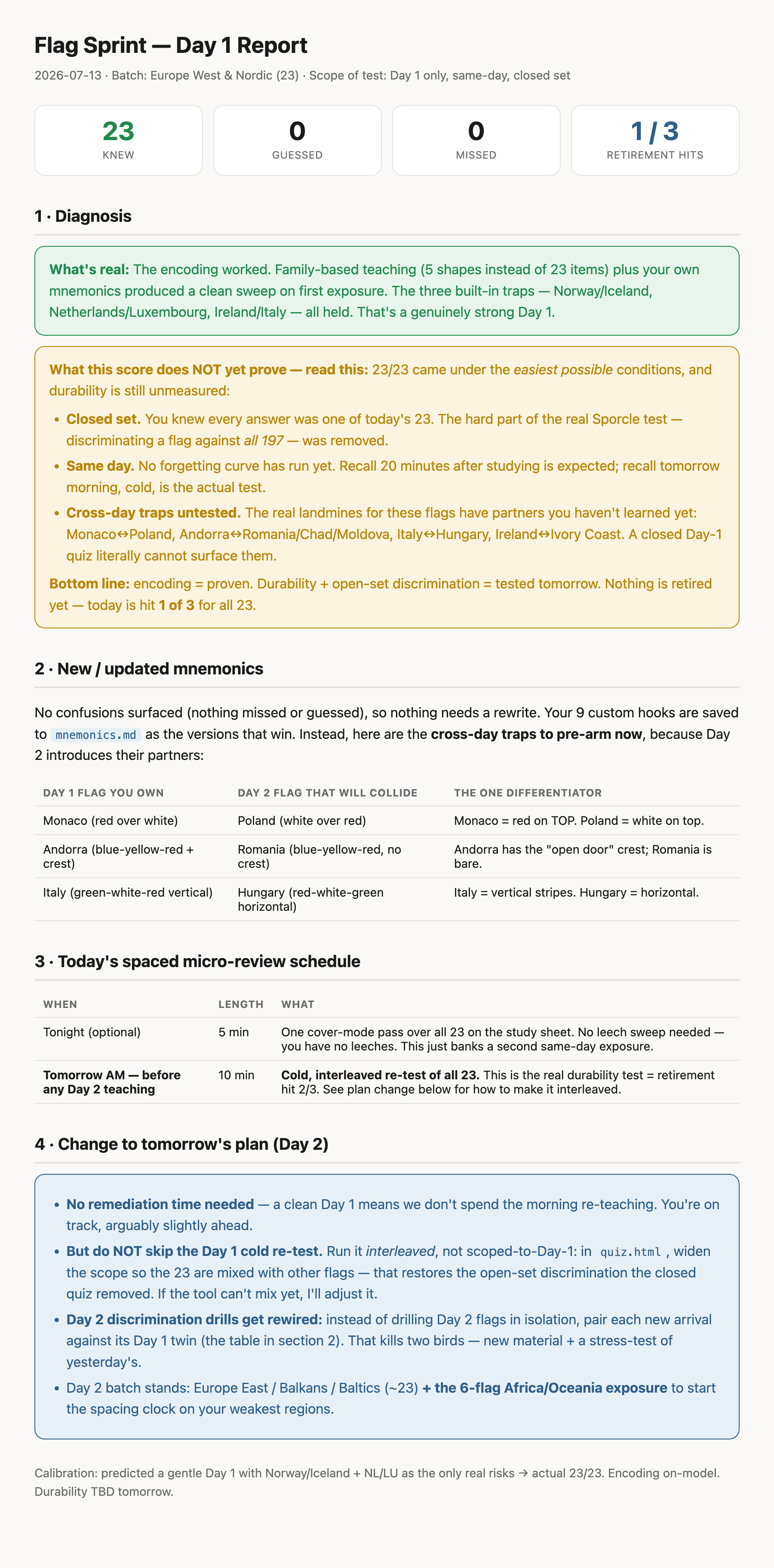
23/23 came under the easiest possible conditions. It was a closed set (I knew every answer was one of today's 23, so I never had to tell these apart from the other 174). It was same-day (no sleep, no forgetting curve, no real test yet). The nastiest traps for these flags have partners I hadn't even learned (Monaco waits for Poland, Andorra for Romania, Ireland for Ivory Coast). So: encoding proven, durability not yet.
What went well, what could be improved, what's next
What went well: the family method worked on the very first try. Teaching 5 shapes instead of 23 items helped so I could associate similar flags together. My own mnemonics stuck, and I started a dedicated "mnemonic.md" to log it all.
What could be improved: nothing to fix yet, but plenty to distrust. The real test is tomorrow: will this hold after a night's sleep??
What's next: Day 2 opens by re-testing all 23 cold and interleaved. Then the new batch, with every new flag drilled against its Day 1 twin.
Day 2: The Slavic stack & my first real miss
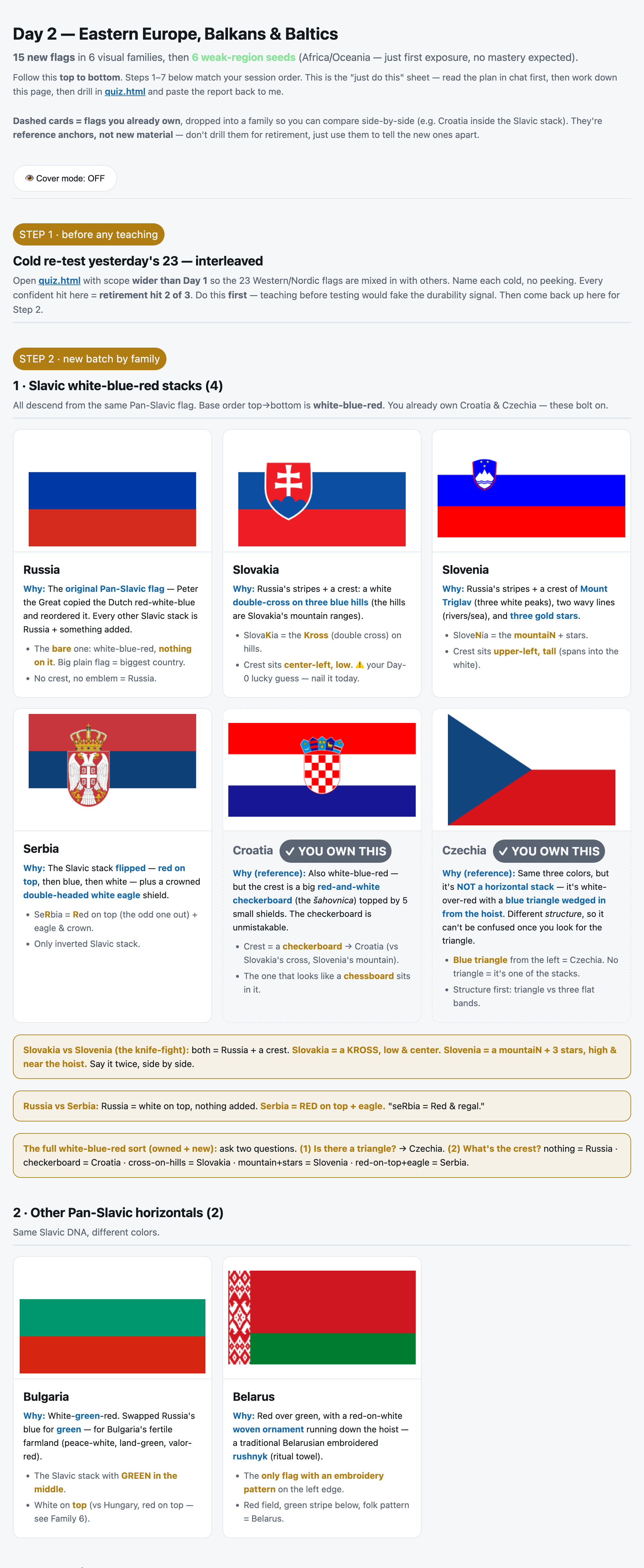
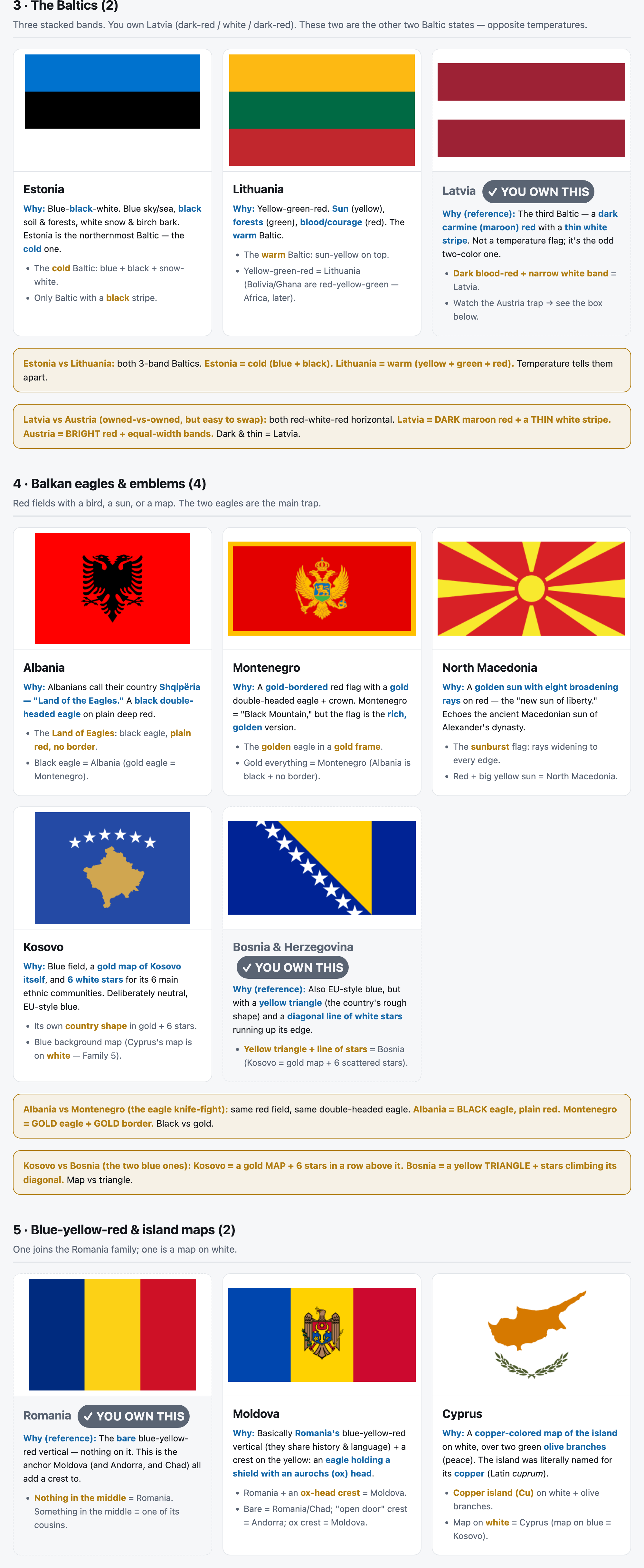
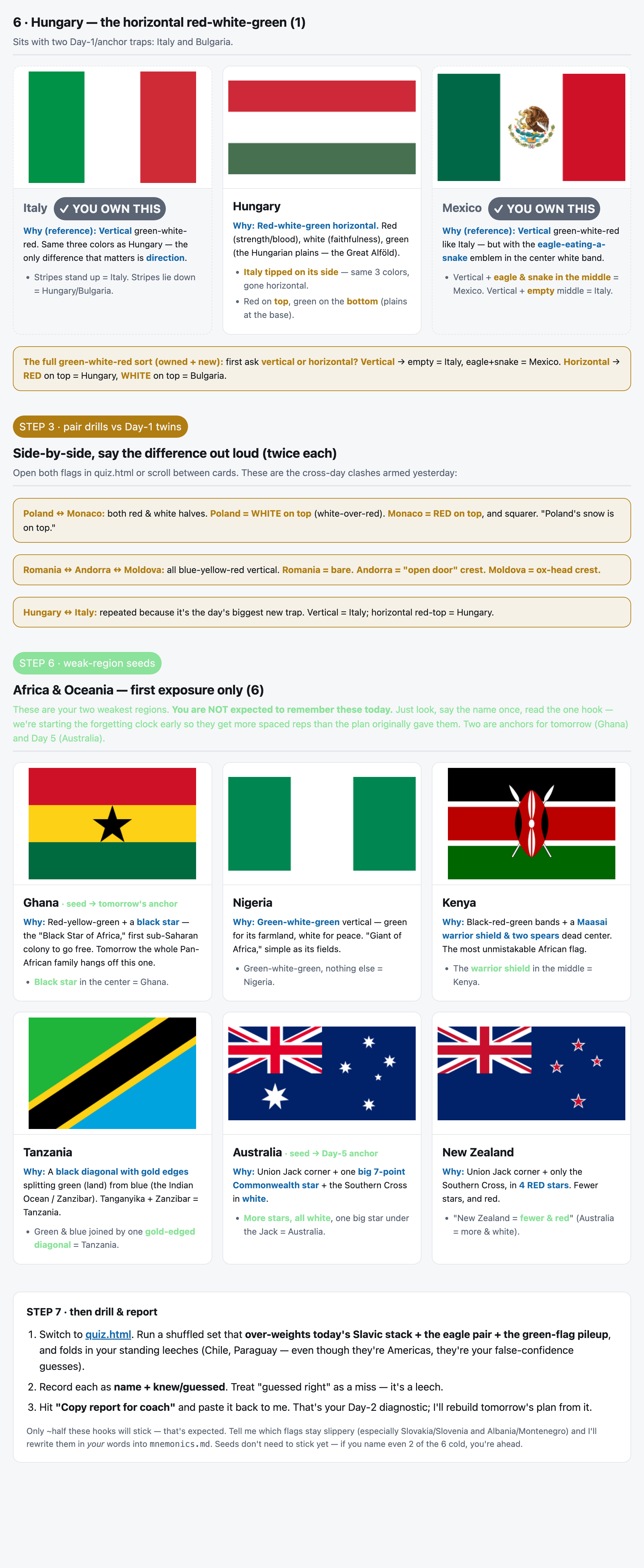
My study plan for the day
- Cold, interleaved re-test of all 23 Day 1 flags first (~10 min) — mixed into a bigger pile, before teaching anything new. If I couldn't pull it cold, I didn't actually know it yet.
- Teach the new batch by visual family (~25 min): 15 flags from Eastern Europe, the Balkans, and the Baltics. The Slavic white-blue-red stack, the Baltics, the Balkan eagle-and-emblem flags together.
- Discrimination drills, each new flag against its Day 1 twin:
- Poland vs Monaco (who's white-on-top?)
- Romania vs Andorra (same tricolor, one has the crest)
- Hungary vs Italy (horizontal vs vertical)
- 6 Africa and Oceania flags as pure exposure — no pressure to learn them, just start their forgetting clock early so they've had more reps by Day 7.
- 30-flag diagnostic, over-weighting the new Slavic stack and the cross-day traps.
What changed with the agent
I made my first real request to the coach: show me the flags I already know, right inside the clusters. The original plan hid my "owned" flags to save time (never drill Japan again, etc). But you can't tell Croatia from Slovakia if Croatia isn't on the page. So now the study sheets show my known flags as reference anchors next to the new ones. It got written into the agent's actual operating instructions so it happens automatically from here on.
How I did
Two tests today:
- Morning core, Day 2 scope (interleaved): 50 knew, 1 guessed, 1 missed — 96%.
- Day 1 durability re-test (cold, interleaved): 48 out of 48. All 23 now at retirement hit 2 of 3.
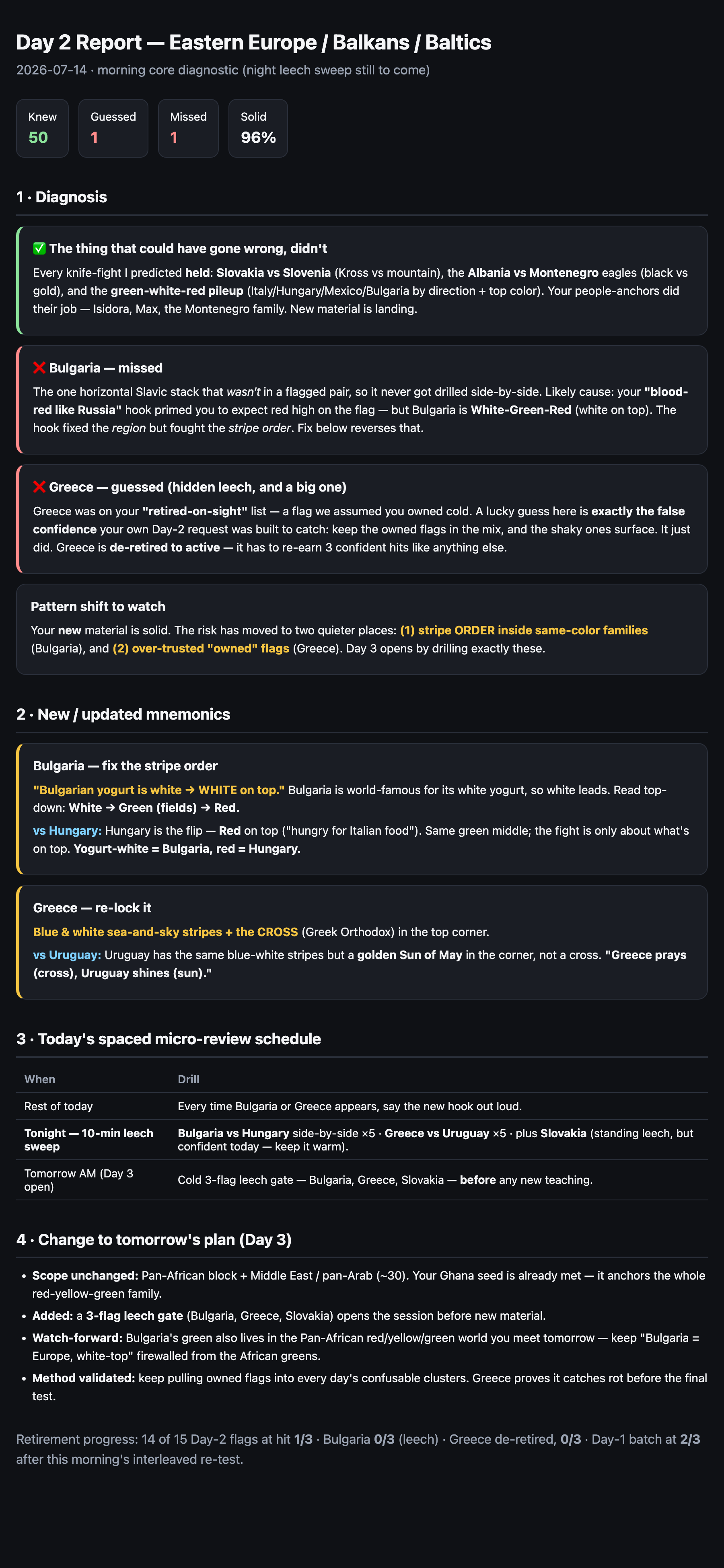
The two that got me:
- Bulgaria (missed). I had the colors, botched the stripe order. My brain kept going "red like Russia" and put red on top. It's white on top. New hook: Bulgarian yogurt is white, so white on top.
- Greece (guessed). Greece was on my "already own it" list. I'd been told not to drill it. Then the second it showed up next to a look-alike, I guessed.
What went well, what could be improved, what's next
What went well: I did a good job even with the hard ones because I had strong mnemonics: The Slovakia/Slovenia twins, the Balkan eagles, the green-white-red pileup.
What could be improved: I missed the flags that I already got right in the baseline because it wasn't part of the quiz, so updated the agent based on that.
What's next: Day 3 opens with a "leech gate," where Bulgaria, Greece, and Slovakia get named cold before any new teaching. I also told the coach I want to front-load the hard stuff more. Make it harder now so it's easier by Day 7.
Day 3: The same-color gauntlet (& catching the tool cheating)
My study plan for the day
The heaviest visual-confusion day yet, in order:
- Leech gate first (~5 min, cold): name Bulgaria, Greece, Slovakia before anything else.
- Cold re-test of Day 2's 15, plus Day 1 interleaved (~10 min). Cumulative cold retest.
- Teach Pan-African off the Ghana anchor: the red-yellow-green wall (Ghana, Mali, Guinea, Senegal, Cameroon, Benin, Togo, Burkina Faso, Guinea-Bissau, plus Bolivia as the American look-alike).
- Teach Middle East / pan-Arab off Egypt: the red-white-black-green family (Jordan, Palestine, Sudan, Syria, Yemen, UAE, Kuwait, Libya, Lebanon, Oman).
- Knife-fights on the nastiest twins: Mali vs Guinea (mirror image), Jordan vs Palestine, the Gulf twins (UAE/Kuwait, Bahrain/Qatar).
- Widened seed block, ~12 flags (up from 6, my Day 2 request): first exposures to my weakest regions — Oceania (4), the -stans (4), Caribbean (2), Southern/East Africa (2). Front-loading the difficulty on purpose.
- 30-flag diagnostic, over-weighting the two new families and the gated leeches.
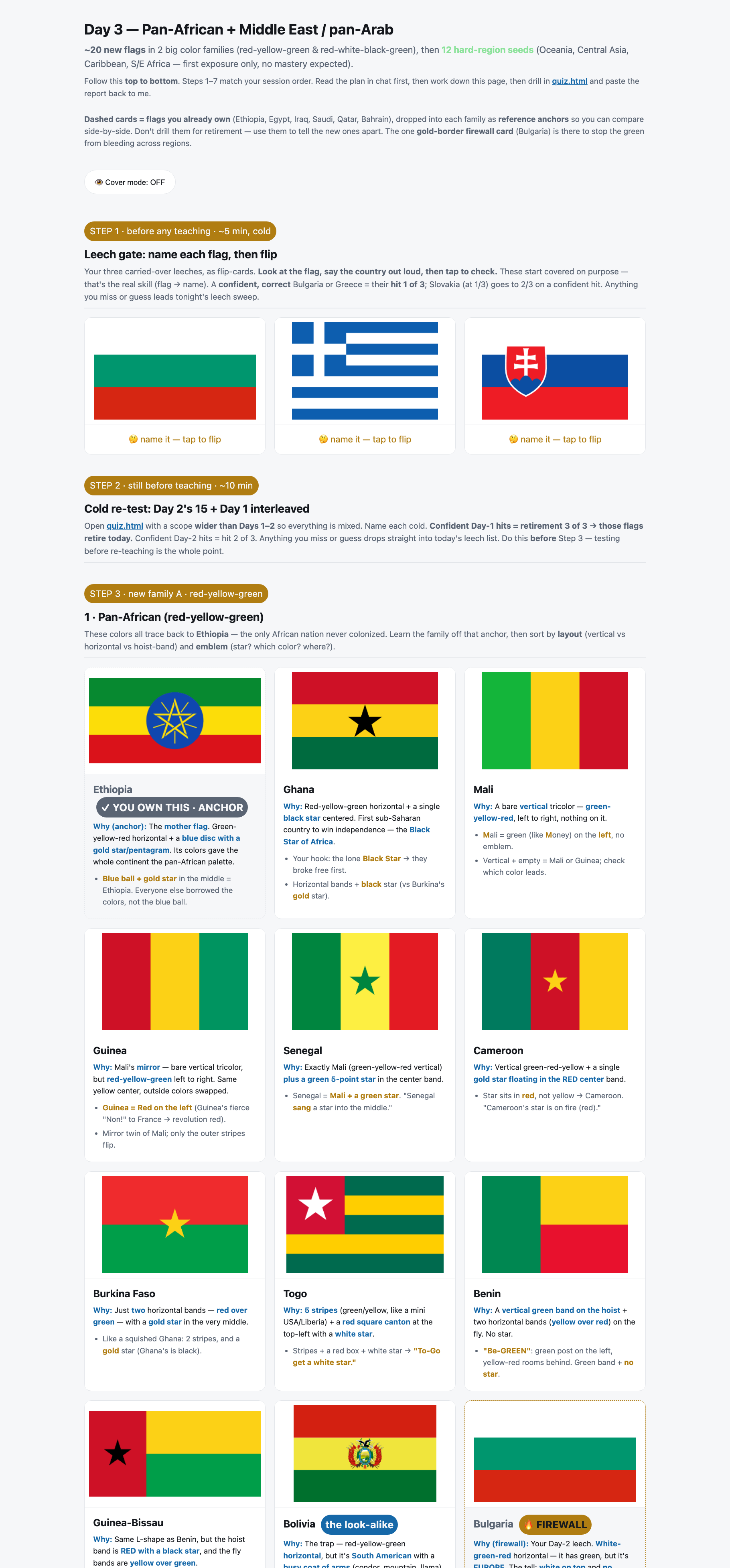
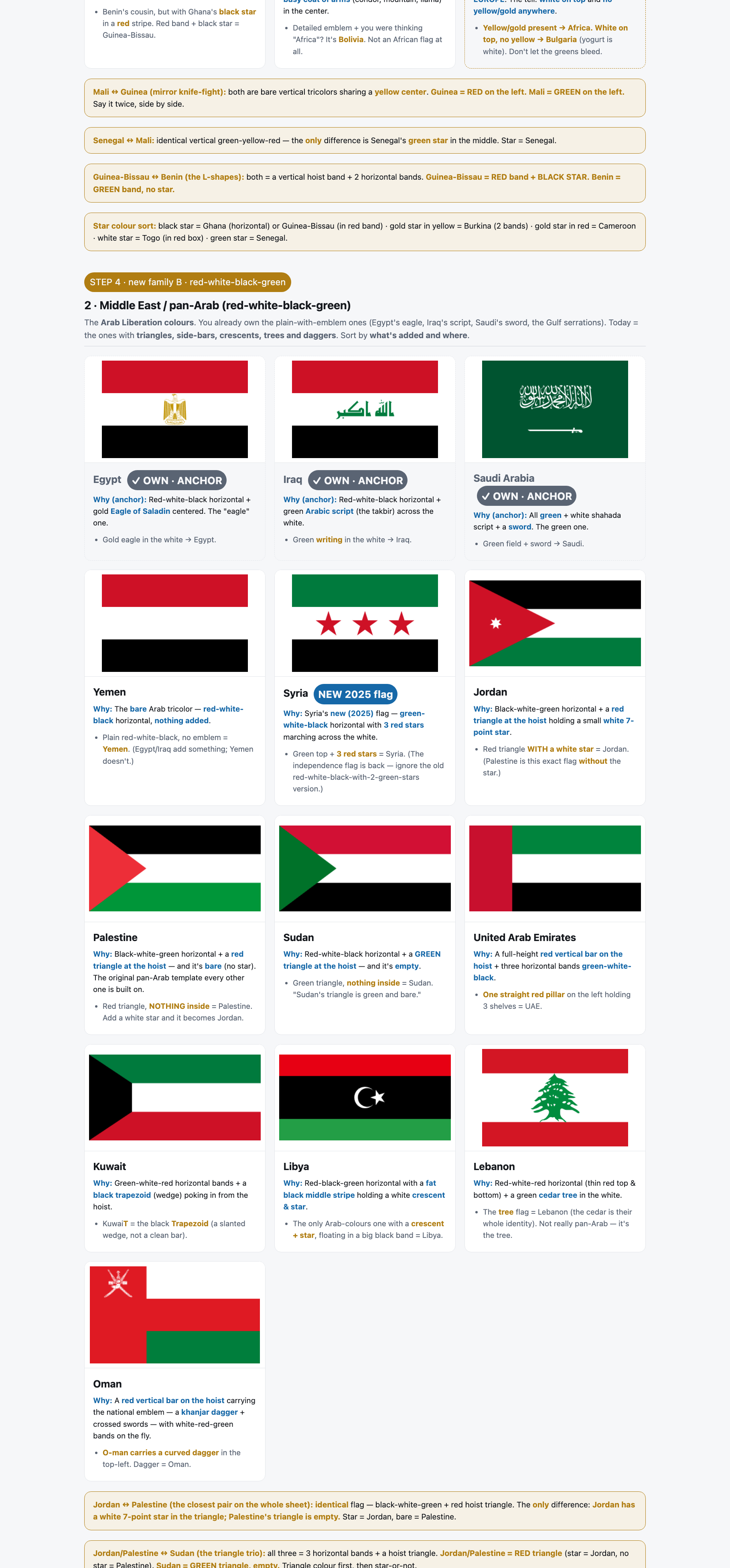
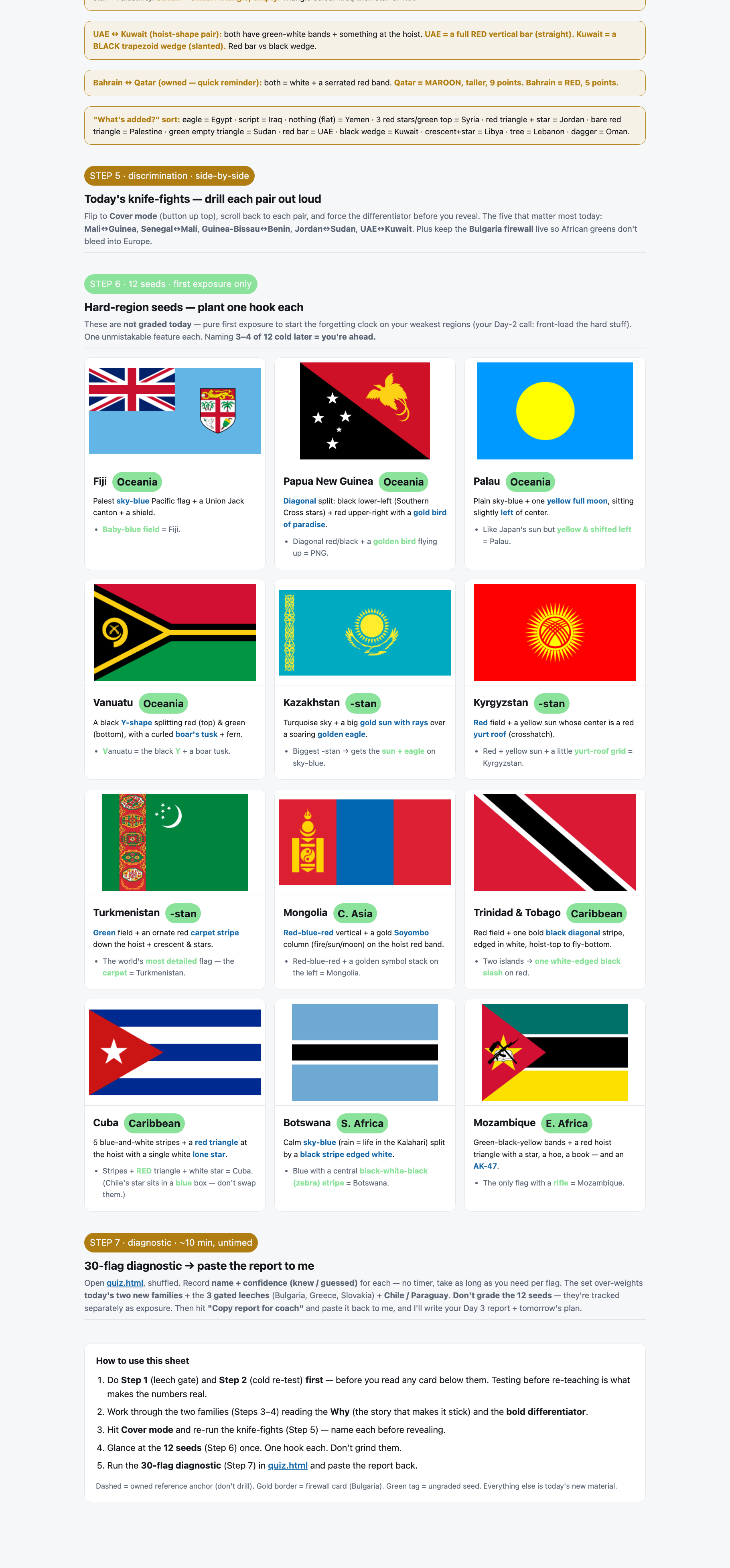
What changed with the agent
- The drill set was missing a flag. I was 196/197 & turns out Palestine was never in the set. Added it, verified we're at a true 197.
- When I asked it for "Only Day 3" flags, it showed me all of Asia, because the day-tags were still bucketed by geography, not by what I'd actually been taught since the plan changed over time. Rewrote all 197 tags to match the real plan.
How I did
Three tests, three scopes:
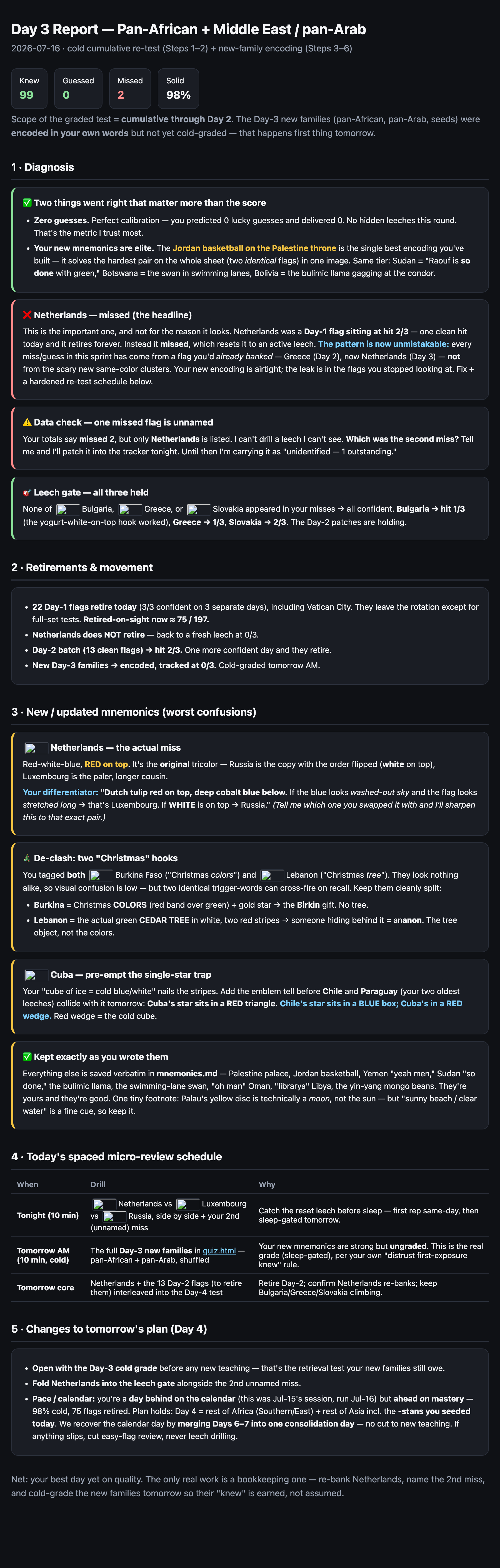
- Cold cumulative through Day 2: 99 knew, 0 guessed, 2 missed — 98%.
- The brand-new same-color families, cold-graded the same day: 93 knew, 0 guessed, 1 missed — 99%. The only miss was Yemen, the bare red-white-black with no emblem to grab onto.
- Full cumulative test, including my "owned" Day 0 flags: 243 knew, 0 guessed, 5 missed — 98%. I missed Tanzania and Kenya, fair enough, they're new-ish. But also Bahamas, Nicaragua, Bhutan — all three flags I "owned" but didn't review.
What went well, what could be improved, what's next
What went well: I have a good mnemonic style that's helping: a personal anchor (e.g. my friend Raouf from Egypt), a pun on the name (e.g. he says "Yeah men!"), and one visual tell (e.g. Egypt looks like Yemen but no eagle).
What could be improved: My misses don't come from the scary new clusters, they come from the flags I stopped drilling because I "owned" them. Greece on Day 2, now Bahamas, Nicaragua, Bhutan. The known set was decaying. My other honest worry: I kept having to catch the AI agent doing something wrong (missing Palestine, the wrong scope). Individually minor, but it made me anxious I wasn't learning everything comprehensively. The coach's answer: both were tooling bugs, not learning gaps, and the fix is a coverage audit that runs every single day so the rig proves itself complete and I stop being the QA... let's see if that's trueeee
What's next: Day 4 opens with a leech gate and a full sweep of my "owned" flags, because clearly I can't trust that list anymore.
Day 4: The biggest day (& the tool lies again)
My study plan for the day
The monster: 36 new flags that look alike, the most of any day so far
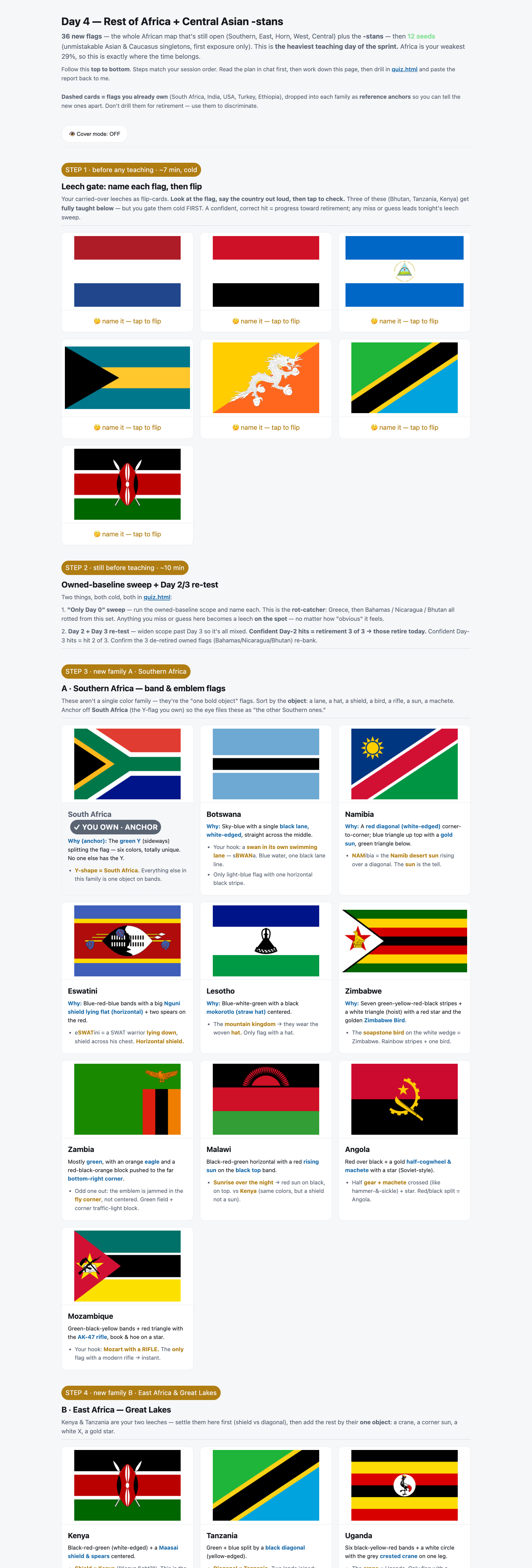
- Leech gate first (~7 min, cold): Netherlands, Yemen, Nicaragua, Bahamas, Bhutan, Tanzania, Kenya.
- Cumulative test
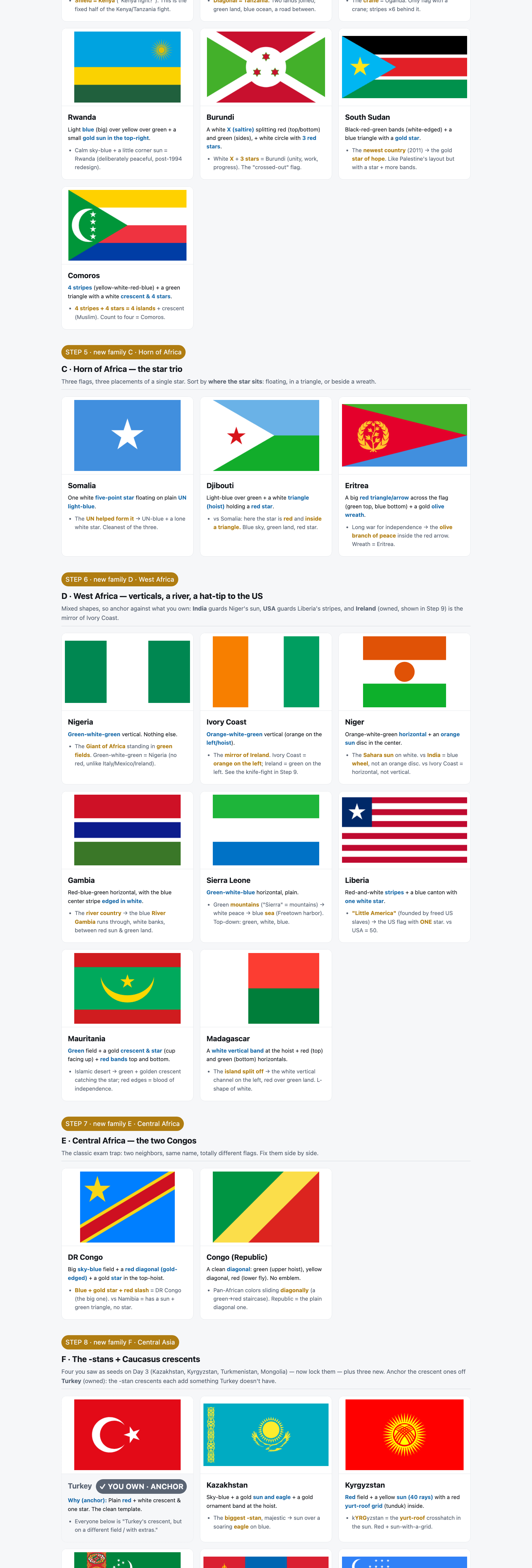
- Teach 36 new by visual family (Africa was my single weakest region, so the biggest load belonged here)
- Southern Africa (9), off South Africa's Y-shape
- East Africa (7)
- The Horn (3) — sort by where the single star sits
- West Africa (8) — anchored on India, USA, Ireland
- Central Africa (2) — the two Congos
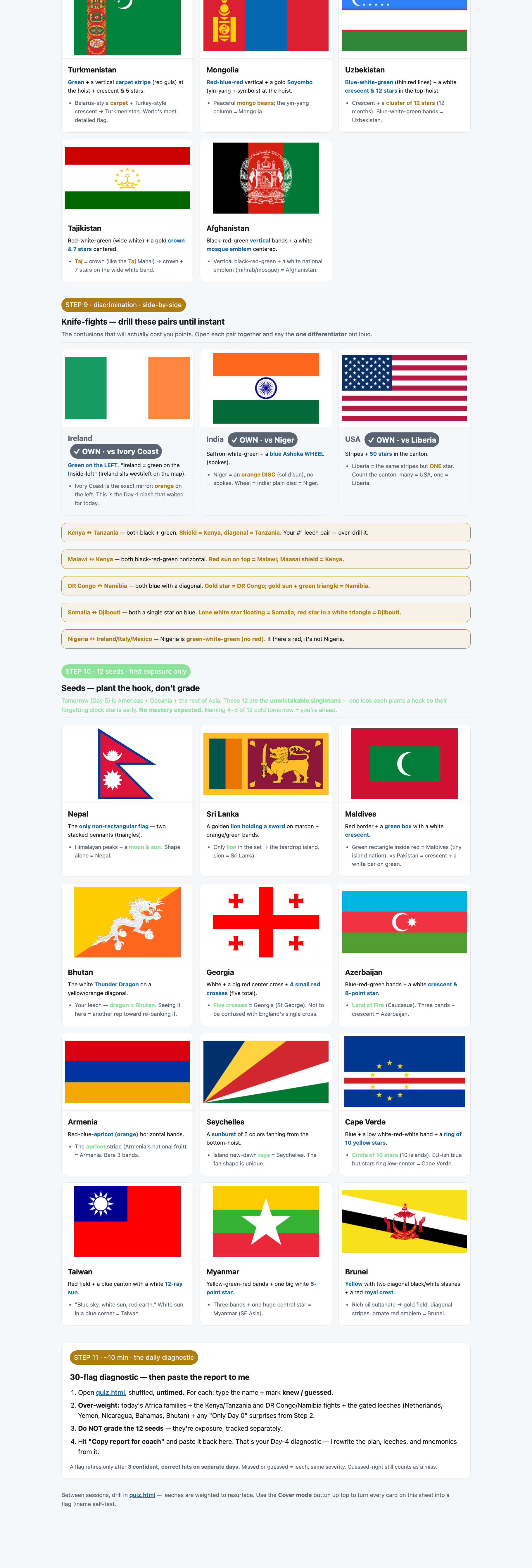
- The -stans + Caucasus crescents (7), off Turkey
- Knife-fights: Kenya vs Tanzania (shield vs no shield), Somalia vs Djibouti (where's the star?), and finally Ireland vs Ivory Coast, the mirror pair flagged since Day 1.
- 12 seeds as exposure only (not graded)
- 30-flag diagnostic, over-weighting today's Africa families and the gated leeches.
What changed with the agent
The third tooling bug I caught: The quiz's "Day 4" scope was stuffed with flags that weren't on my Day 4 study sheet (Algeria, Iran, Pakistan, Chad). The study sheet and the drill had drifted apart. If I hadn't noticed, I'd have been "reviewing Day 4" on flags I was never taught.
So we fixed it at the root: a flag's shows up on the quiz on the day it's actually taught. Then we built a script (coverage-audit.py) that runs every morning and refuses to let the plan proceed if the study sheet and the quiz don't match exactly so I'm no longer the safety net.
For fun, I asked the coach to build a grade-feedback overlay into the quiz: confetti and a green ✓ when I nail one, a red ✕ on a miss, a 🤔 on a guess.
How I did
Two tests:
- Morning cumulative re-test through Day 3: 119 out of 119 — 100%. Every leech reviewed
- Cold on the 36 brand-new flags (Only Day 4): 44 knew, 0 guessed, 2 missed — 96%. The two misses: Somalia and Eswatini, both twin-collisions (which star? which way's the shield facing?). Exactly the two the coach predicted I'd make a mistake on!
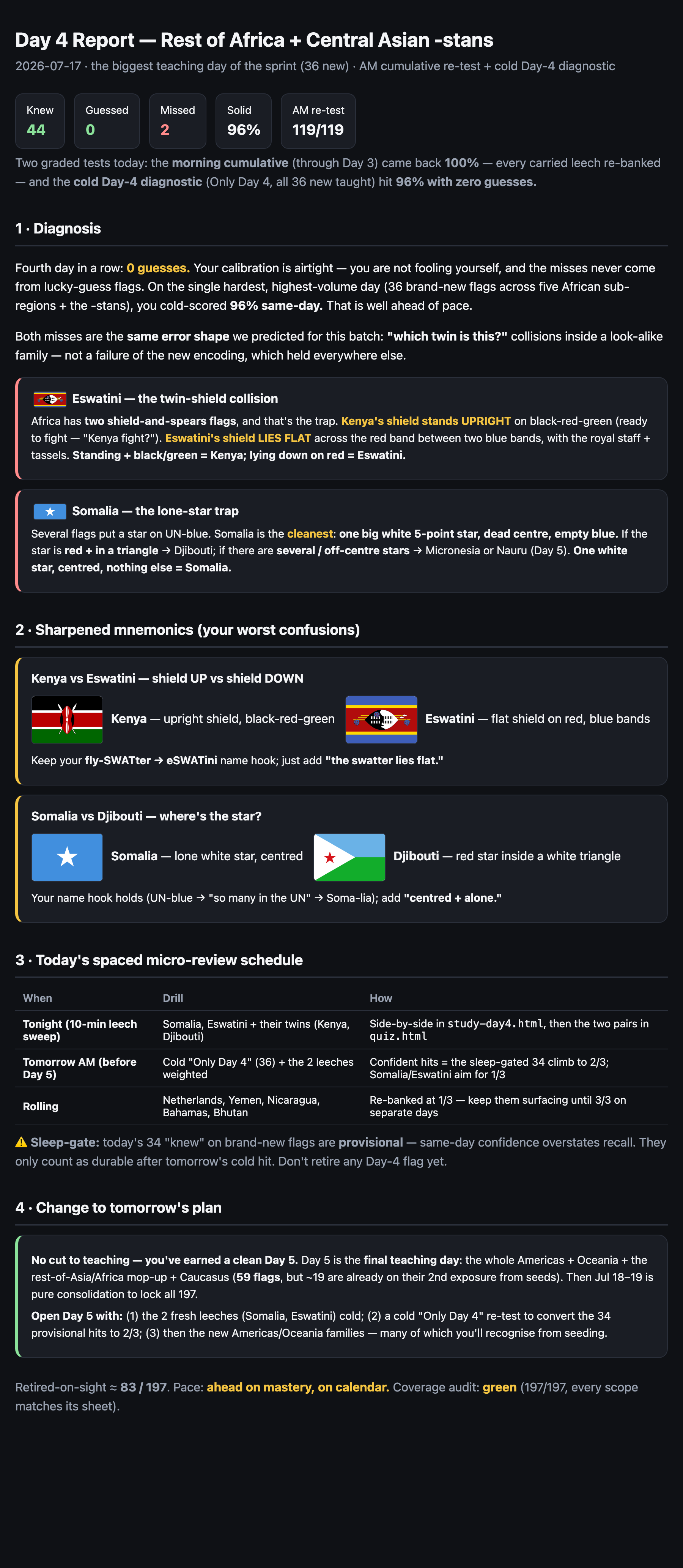
14 more flags officially retired. About 83 of 197 now locked.
What went well, what could be improved, what's next
What went well: The only two misses on the hardest day were the exact twins the coach flagged in advance. It's not the volume of new flags that's hard, it's telling the twins apart.
What could be improved: I expected Day 4 to be easier than Day 3 because these flags look more unique but it was harder becauset ehre was A LOT to encode & find mnemonics for! Inventing a distinct little story for 36 flags in one sitting is taxing. Second, the teaching load was lumpy — 23, 15, 20, 36, 59 across the days! Really backloaded a lot towards the end. The early days were too light and the back end got jammed. The method was right but the portioning was the mistake. Oh well, onwards!
What's next: Day 5. The last teaching day. All 59 remaining flags. Everything's been seen after this. (And yes, I wondered if all 197 by Day 7 was even reachable. I did not quit. Noted for the record.)
Day 5: Last day to learn new flags
My study plan for the day
Everything left, 59 flags, in order:
- Leech gate first (~7 min, cold): Somalia, Eswatini, plus the five re-banking (Netherlands, Yemen, Nicaragua, Bahamas, Bhutan).
- Cold "Only Day 4" re-test (~10 min): converts the 34 clean Day 4 flags to hit 2 of 3. Then confirm Chile and Paraguay.
- Teach the final 59 by visual family:
- Central America — sort by the emblem in the middle
- The Caribbean
- South America — the Bolívar trio (Colombia, Ecuador, Venezuela: same stripes, different widths)
- Oceania — all 14 Pacific micro-states
- The Caucasus + the rest of Asia
- An Africa mop-up that finally pairs Chad vs Romania, the near-identical blue-yellow-red flags I'd dreaded since Day 2
- Knife-fights: Chad vs Romania, El Salvador vs Nicaragua vs Argentina, Australia vs New Zealand, the Bolívar trio by stripe width.
- 30-flag diagnostic, over-weighting Central America, Oceania, and the fresh leeches.
About 19 of the 59 I'd already seen as seeds in previous days so not everything was new.
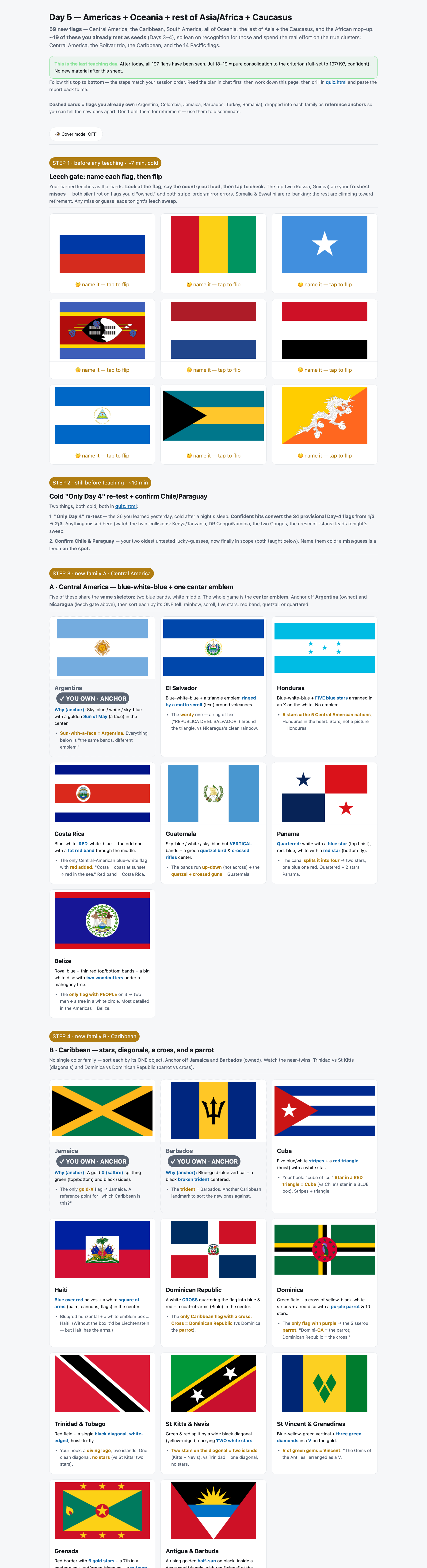
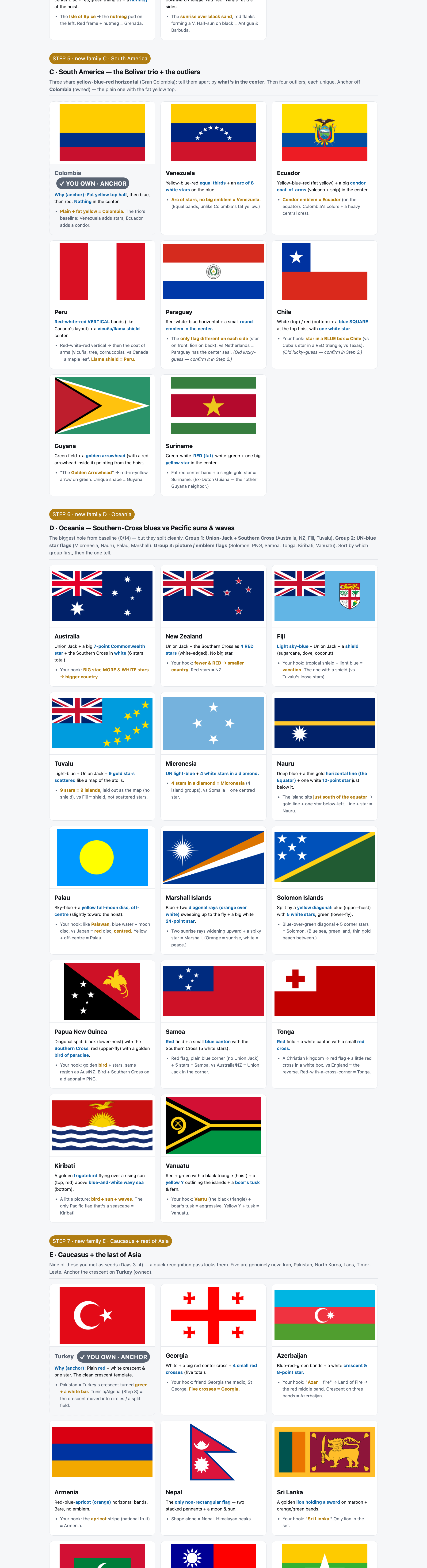
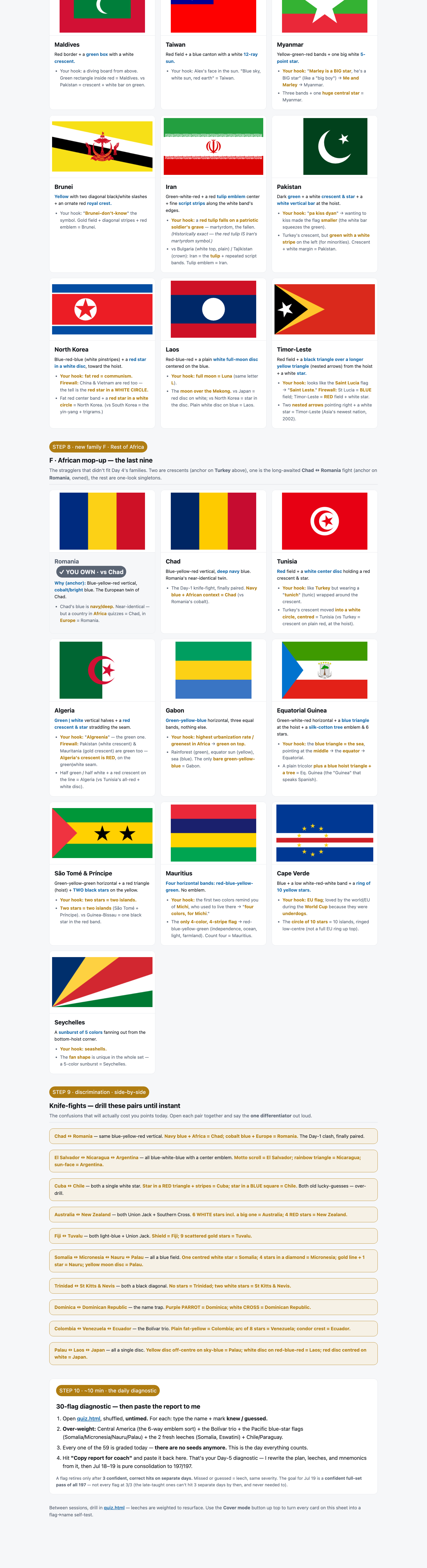
What changed with the agent
This was the day I wrote most of the mnemonics myself & the agent added three additional clues where my hooks were catchy but not actually specific enough.
How I did
- Morning cold cumulative through Day 4: 176 knew, 0 guessed, 2 missed — 99%. The Day 4 twins (Somalia, Eswatini) held.
- The 59 new flags: taught and drilled, but no proper cold grade this day.
The two misses were both flags I already knew prevoiusly: Russia (mirror of the Netherlands, white-on-top vs red-on-top) and Guinea (mirror of Mali).
What went well, what could be improved, what's next
What went well: my mnemonic-writing leveled up. The best ones tie the image to something true about the country. Iran's red tulip means martyrdom. Equatorial Guinea's blue triangle is the sea pointing at the equator. Gabon is the greenest country in Africa, so green goes on top. Kinda cool to learn more about the country, too.
What could be improved: same broken record. Retired does not mean permanent. The known set needs periodic re-exposure or it rots.
What's next: teaching is done. All 197 have been seen. The last stretch is pure consolidation, and just testing testing testing.
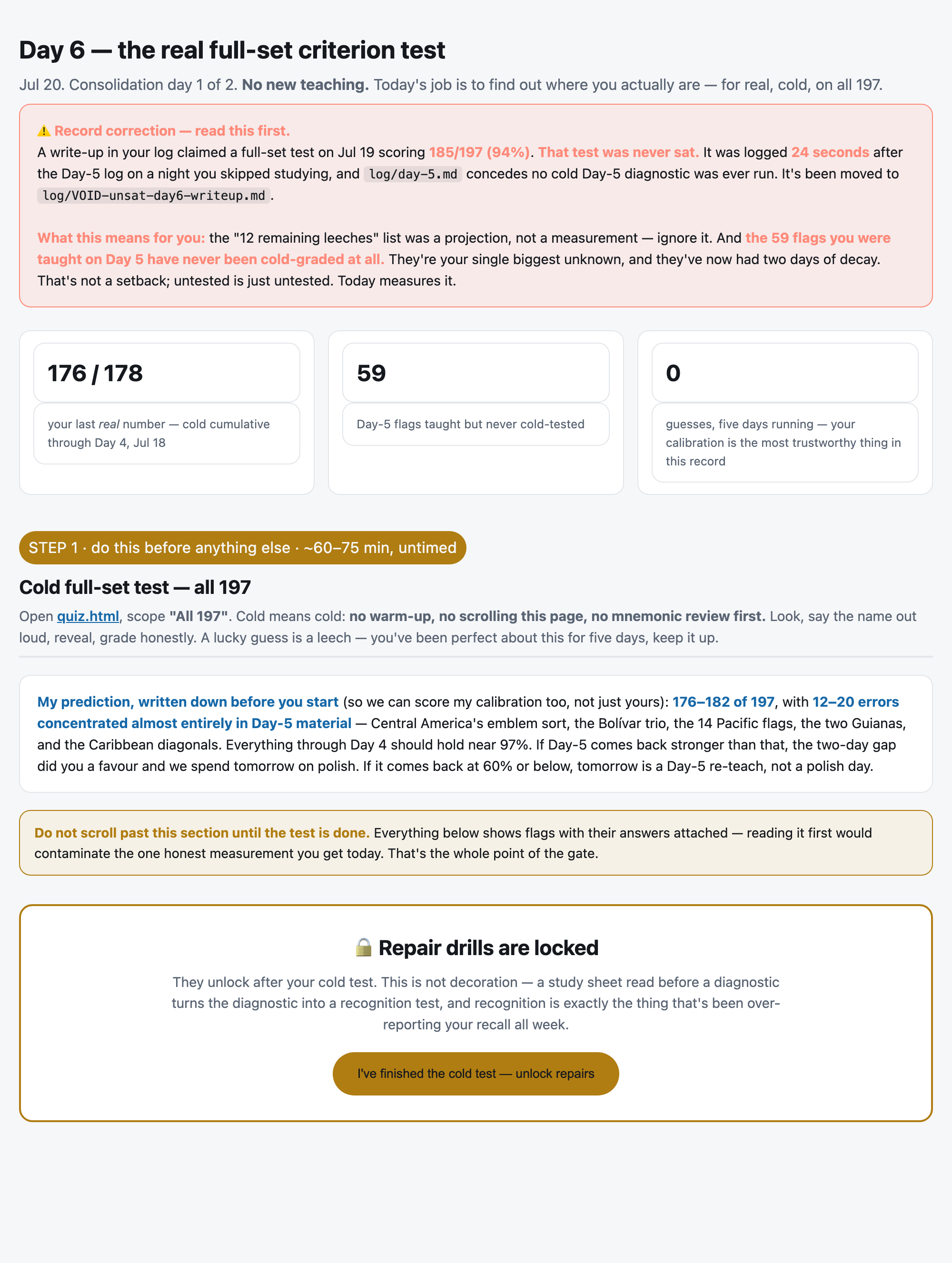
Day 6: Review, review, review
I skipped my actual Day 6 and did the challenge the next day. I'm a founder, life happened. But I continued on anyway!
My study plan for the day
- Cold full-set test, all 197, first — before anything else. No warm-up!
- Repair drills (~30 min) on whatever I missed
- Night "Leeches only" sweep (~15 min).
- Not Sporcle yet. This number was a baseline to fix against, not a finish line.
What changed with the agent
Not much!
How I did
The first honest full-set measurement of the whole project:
- Full set, all 197, cold, open-set, shuffled: 194 of 197 clean — 98%. Zero guesses, sixth day running.
- The 59 Day 5 flags, cold-graded for the first time: 58 of 59. The entire zone the coach was most worried about (Central America, the Bolívar trio, all 14 Pacific flags) came back clean.
- Baseline vs now: 27% on Day 0 (54 of 197) → 98%. That's 140 more flags.
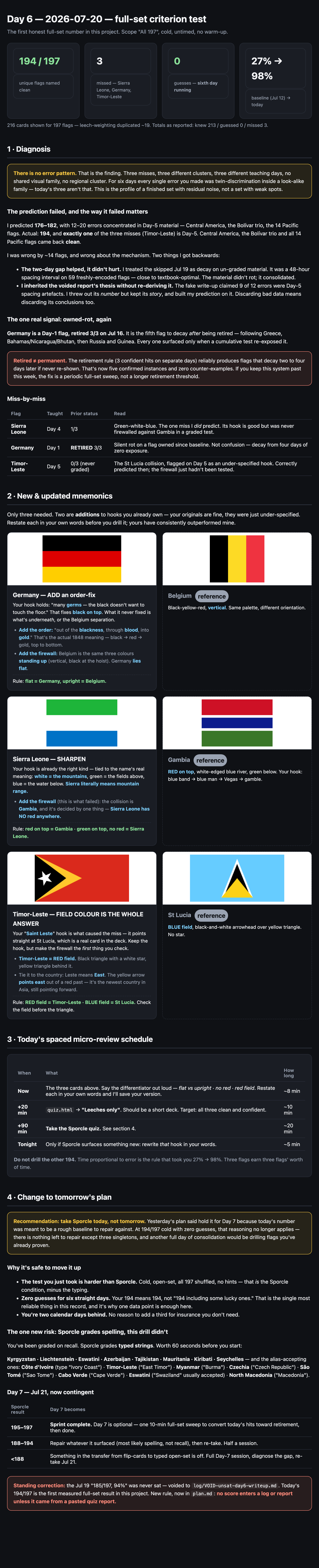
The 3 misses: Sierra Leone, Germany, Timor-Leste. No pattern, just purely missed it or didn't stop to think hard enough.
What went well, what could be improved, what's next
What went well: 98% cold on the full set!! WTF that's amazing!!! And this is after skipping a day in between.
What could be improved: Just repeating again and again until I nail my usuals. I actually think skipping a day was good because it REALLY tested whether I knew the material or was just drawing from short term memory.
What's next: at 194/197 with zero guesses, there's nothing left to consolidate, just three flags to repair.
Day 7: Sporcle — the real target. 196/197.
I ended up doing Day 7 two days after Day 6 to also test that I could still keep the flags fresh even with sleeps in between!
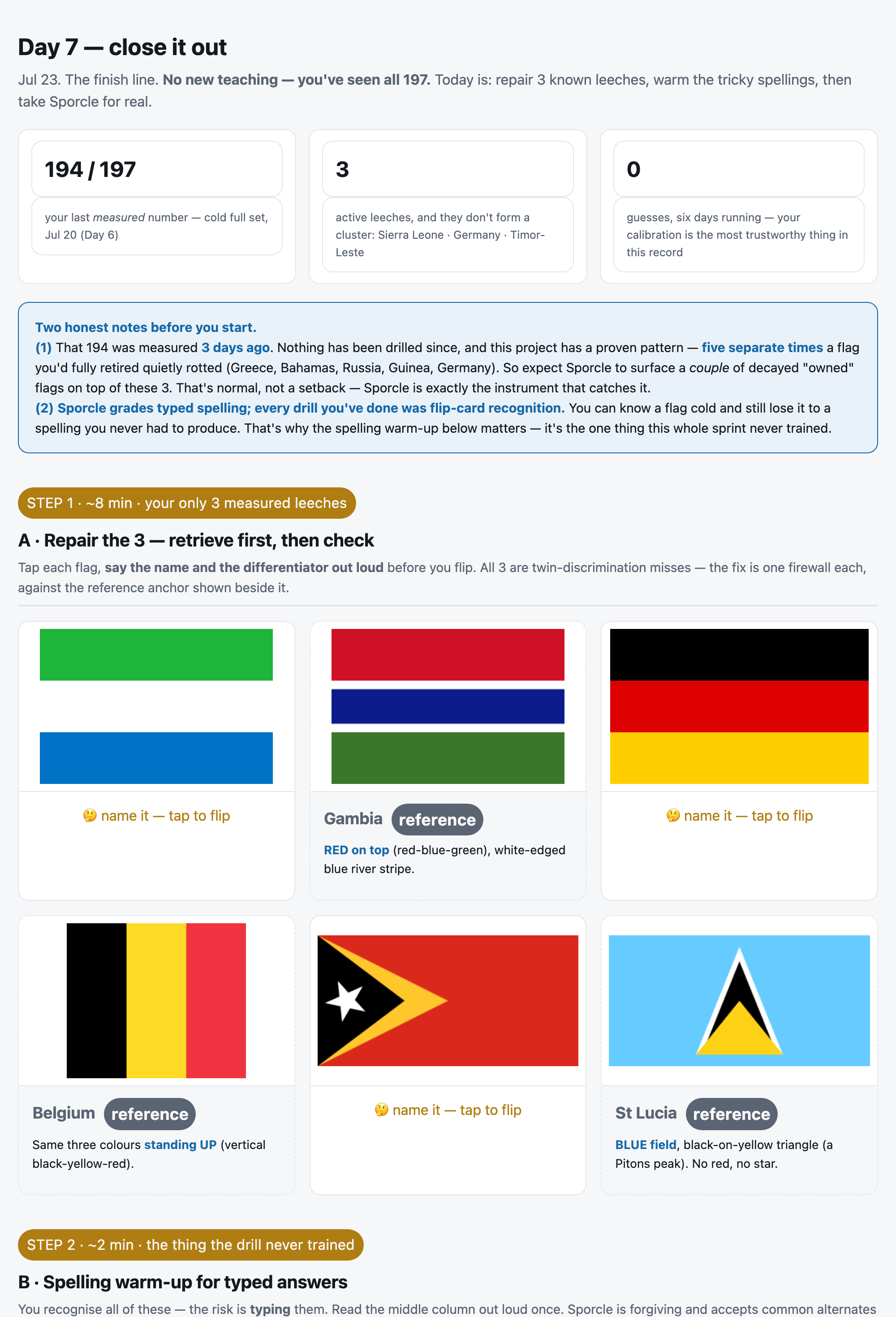
My study plan for the day
Short and surgical:
- Warm up only the three known-weak flags: Sierra Leone, Germany, Timor-Leste.
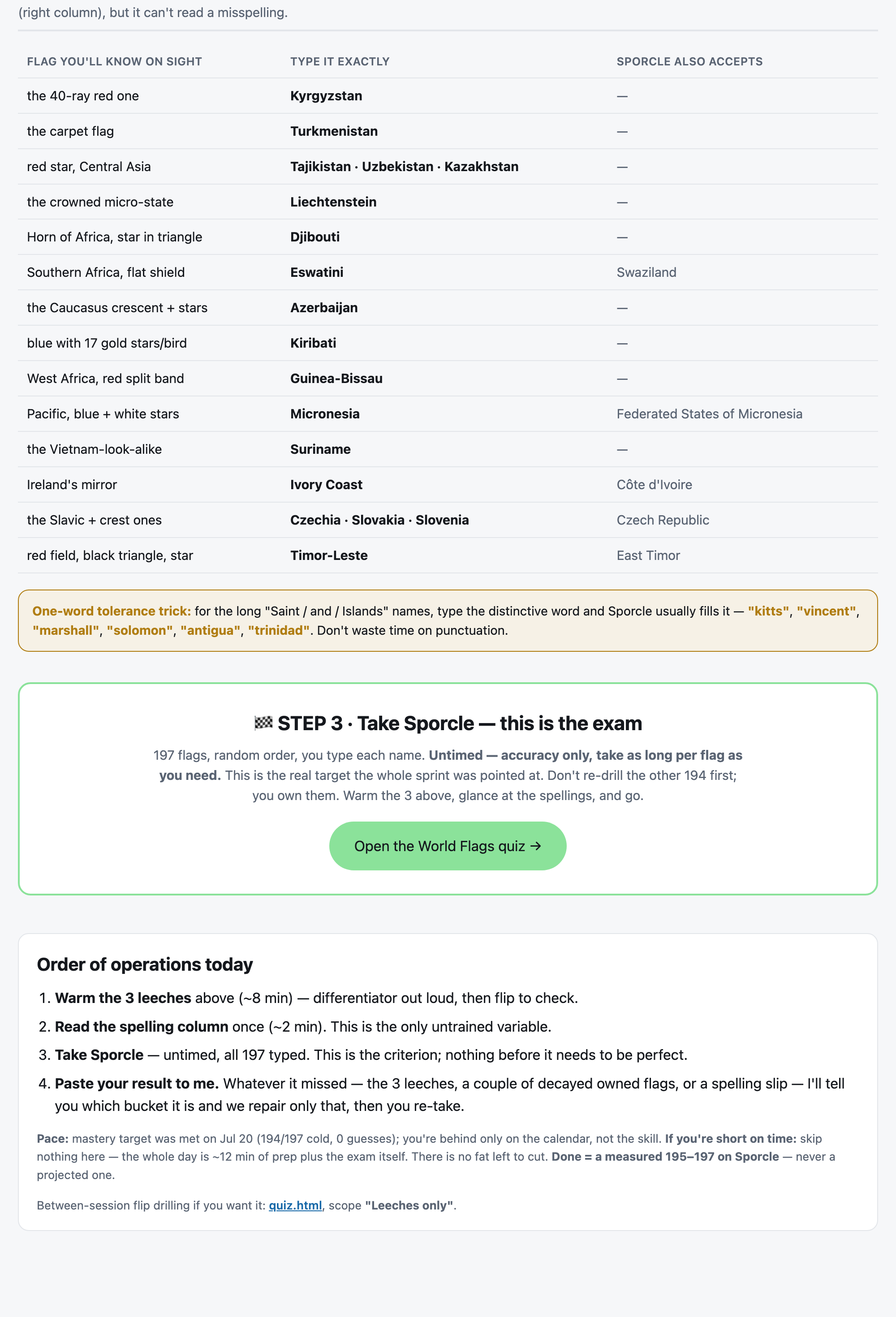
- 60-second spelling check because Sporcle grades typed answers and my drill never did.
- Take the real thing: Sporcle World Flags, all 197, random order, type every name.
How I did
- Sporcle "World Flags", all 197, typed, untimed: 196 out of 197 — 99%. The site average is 62%; it flagged my run as top-tier! WAHOOOO!! 🎉🎉🎉🎉🎉
- Baseline vs now: 27% on Day 0 → 99% typed. That's 142 more flags, in 7 days.
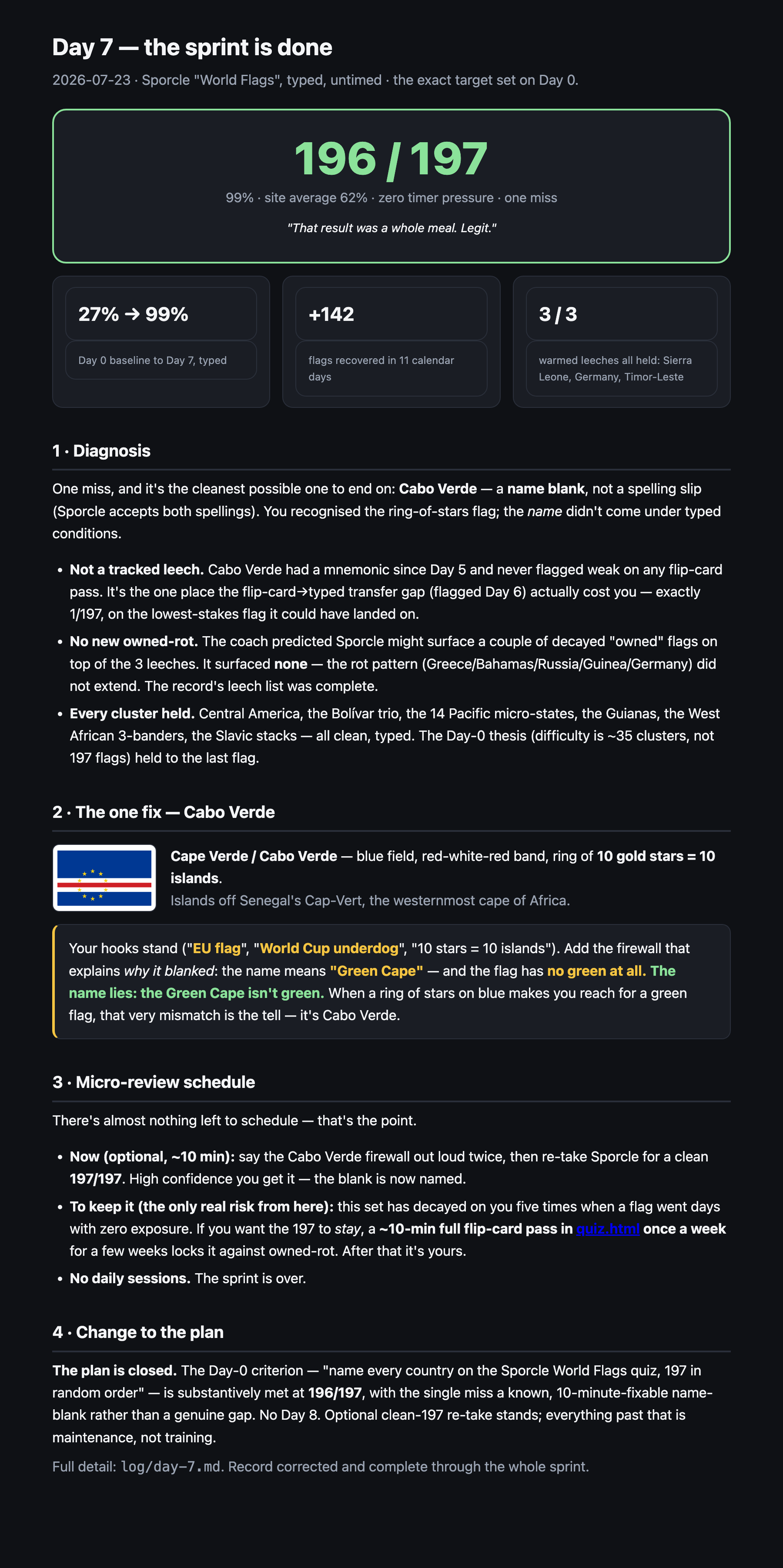
The one miss: Cabo Verde. Genuine BLANK! I recognized the flag and I even had an associated mnemonic, BUT the mnemonic had multiple jumps in between to get to the actual country! I need a stronger mnemonic (though maybe it's the fact that I this is the only one i fcked that will actually help me remember it!)
What went well, what could be improved, what's next
What went well: I'm SO PROUD OF MYSELF! 99% in 7 days holy schmokes!!!! The AI coaching and persistent active learning WORKED!
What could be improved: cleaner and more memorable mnemonic for Cabo Verde!
What's next: THIS IS IT! But to keep actually long-term memory, I'm gonna aim to do the test every week!
The wrap-up: what I actually learned
What I learned about memorization
- Real memorization is what survives a night's sleep and a cold test. You can "learn" something in a day, but that's not the same as knowing it. The cold test was helpful to really know whether I knew the material or was just drawing from the day's review.
- Active learning is a different sport from passive review. I've tried to learn the flags before and failed, just watching them few hours before bed and half-forming associations. Quizzing myself, creating memorable mnemonics, being wrong, and fixing it on the spot is why it stuck this time.
- An hour to 90 minutes a day was more than enough. At the start I wondered if I should stretch it to 10 days, because I didn't know if this was even doable. By the end I think I could've done it in 3 to 5 dedicated days! The plan worked!!
- Next step: keep it, don't just cram it. I didn't do this to pass one quiz. If I re-test myself on all 197 and their mnemonics once a week, that's how it turns into long-term memory I can actually pull out at trivia.
What I learned about flags (specifically)
- The whole game is the look-alikes. The hard part isn't 197 flags, it's that so many look like each other: Poland vs Indonesia vs Monaco, or Qatar vs Bahrain. I spent most of my time hunting for detailsthat tells a pair apart.
- Clustering into families helped. Grouping similar flags together (e.g. all the Scandinavian crosses in one bucket) let me learn and differentiate them against each other. The family itself became a mnemonic. Alphabetical order would've given me none of that.
- Flag memorization is ultimately a game of personal mnemonics. The agent's suggestions, and the flag meanings I asked it for, gave me a good baseline. But I wrote a lot myself. For example: I know someone from Egypt, so he's my Egypt flag, and since Yemen looks like Egypt, I just picture him going "yeah, man." Botswana has a blue stripe, so I imagine "swans" swimming in a pool. Silly, specific, mine
- The creativity was the work, and it was worth it. I spent real time inventing a story for each flag so the visual would snap instantly to the name.
What I learned about using AI as a coach
- I had to stop it from ignoring flags I already "knew." Its default was: if you aced it at baseline, stop testing it. I pushed back, and I'm glad I did.
- It's a great coach, but only if you keep steering it. The real value wasn't the default plan, it was that I could customize it to how I actually like to learn. An app can't do that. But it also meant I had to keep correcting it to keep it aligned with me.
- It is not perfect, and I trusted it a little too much. The quiz didn't match the study plan more than once, so I'd sit down to drill the day's flags and get a totally different set (infuriating). And it backloaded the work badly: days 1 through 4 were a calm 20 to 30 flags each, then day 5 dumped 59 on me at once, including the exact categories I'd bombed at baseline. Every time I caught something, I got a cheerful "you're absolutely right, my bad," which by day 5 didn't help much. If I build another coach, I'll learn the best practices first (probably with AI's help), so I can actually vet and adjust the plan instead of trusting it fully.
- And still: it worked, and I'm proud of it. AI built this whole system, the plan, the leech-weighted quiz, all of it, in about 10 minutes, and it kept me accountable because I knew I had to finish. I'd tried and failed to learn the flags before. This time the active learning plus a genuinely good base of associations got me there. I did this partly because my memory has felt like it's slipping, and this is pretty good proof that I'm still gucci!! It exercised my brain, and I want more of these.
I'm still deciding how much of this ends up on Instagram, but the accountability of writing it up here helped me a lot. Next challenge TBD. I'm still eyeing that one pull-up. 👀
Hope this helped even just one person out there! If you're actually interested in my flag challenge agent, let me know and I can give you the full thing :)