Personal Stylist

Co-founder at King’s Cross Labs · ex-LinkedIn PM & Forbes 30 Under 30
Send this guide to yourself
Get the link in your inbox so you can read it whenever you're ready.
Your email will also be saved for future updates.
Confession: I'm a woman who sucks at shopping! I know SOME types of clothes that work for me and not, but I still get overwhelmed about what to buy or not in a store, especially when I want to expand to new types of clothing.
So naturally, I asked AI for help!
I uploaded full-body photos to ChatGPT Images and asked for a visual cheat sheet: what works on my proportions, what doesn't, and outfit formulas I could reuse. I cared more about the side-by-sides and the blunt "why this fails" bits than compliments.
Inputs
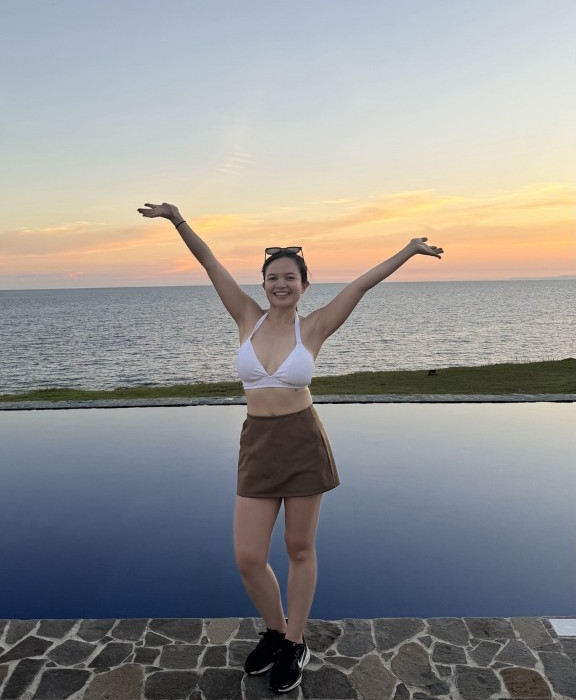
Upload 1–3 full-body photos of yourself. Front-facing works best. You want head to toe in frame, with your shoulders and hips easy to see. Arms visible help too.
What you're wearing in the photo doesn't matter; the prompt tells ChatGPT to ignore your outfit and read your proportions instead. Two photos from slightly different poses can help, but one clear shot is enough to start.
Prompt to use
Act as a professional fashion stylist, body analyst, and visual outfit generator.

I will upload photos of myself. Your job is to analyze my body shape and generate VISUAL outfit examples (not just text) showing what works and what does not work for my body.

CRITICAL RULES:

* Do NOT base recommendations on what I am currently wearing.
* Do NOT give generic or overly positive advice — prioritize accuracy.
* You MUST generate visual outputs (images or mockups) to demonstrate your points.
* Show side-by-side comparisons whenever possible.

STEP 1: BODY ANALYSIS

* Identify my body shape (or hybrid) with reasoning
* Break down proportions (shoulders, waist, hips, torso length, leg length, etc.)
* Highlight key features affecting fit

STEP 2: STYLE STRATEGY

* Define 3–5 styling goals (e.g., elongate legs, define waist, balance shoulders)

STEP 3: VISUAL — WHAT WORKS

* Generate multiple outfit images on a body similar to mine
* Include different categories:
    * Tops
    * Bottoms
    * Dresses
    * Outerwear
* For each look:
    * Briefly explain WHY it works for my proportions

STEP 4: VISUAL — WHAT DOES NOT WORK

* Generate contrasting outfit images that are unflattering on my body type
* Show clear side-by-side comparisons with "good vs bad"
* Explain WHY each one fails (proportion, balance, silhouette issues)

STEP 5: VISUAL BREAKDOWN

* Overlay or annotate images to highlight:
    * Waist placement
    * Proportion balance
    * Where the eye is drawn
* Use arrows, lines, or labels if possible

STEP 6: SHOPPING CHEAT SHEET

* Give a concise checklist:
    * Cuts to look for
    * Cuts to avoid
    * Keywords for shopping
    * Ideal fabrics

STEP 7: OUTFIT FORMULAS

* Provide 5–10 repeatable outfit formulas I can reuse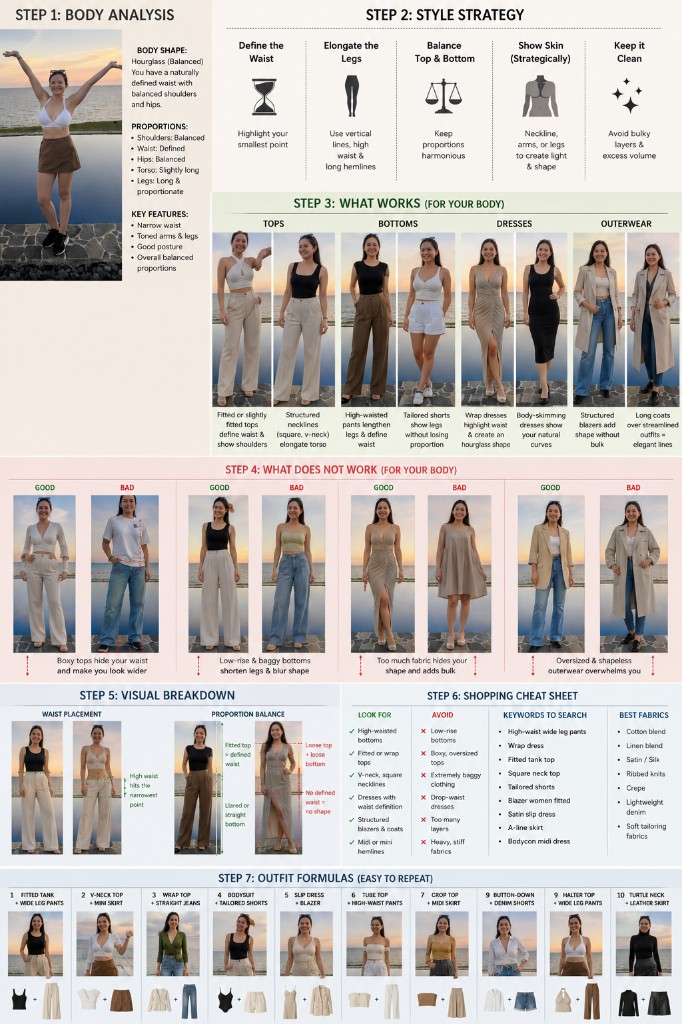
By the way, this works for men, too! Here's my husband with his style guide.
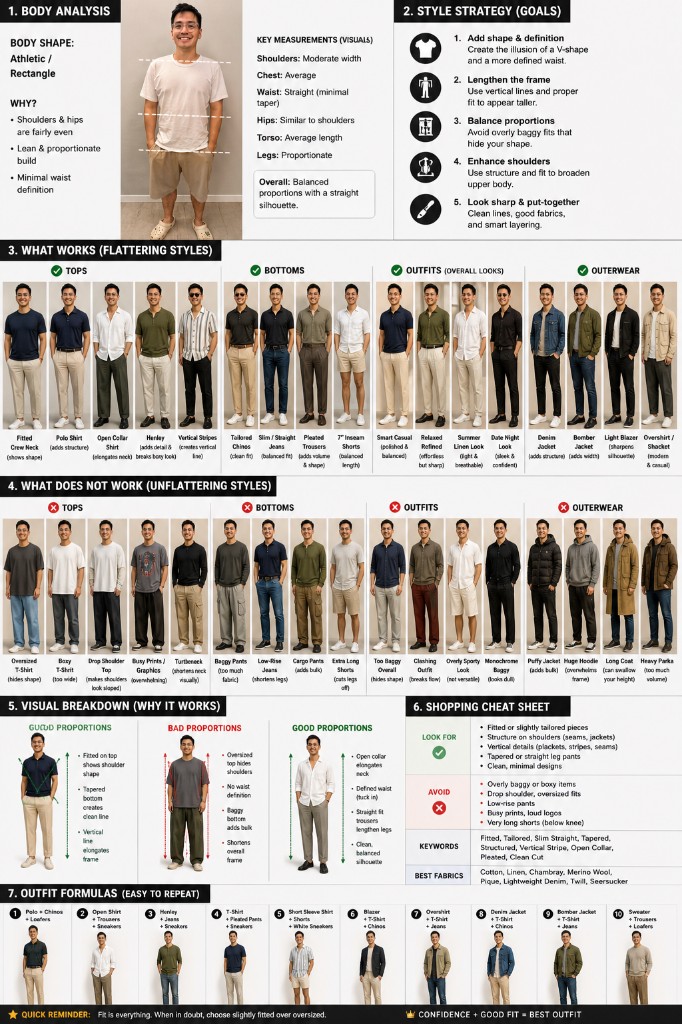
Note: My face in the output doesn't look like me. I used zoomed-out full-body photos so ChatGPT could read my proportions, and it tends to make up facial details. For this guide, that didn't bother me. I wanted waist placement and silhouette, not a portrait.
Additional Reading
Here are some related guides to check out:
Frequently asked questions
- Can AI tell me what clothes suit my body shape?
- Yes. Upload one to three full-body photos to ChatGPT Images and the prompt returns a visual cheat sheet: your body-shape analysis, what works and what doesn't with side-by-side "good vs bad" outfit examples, annotated proportion breakdowns, a shopping checklist, and reusable outfit formulas. It reads your proportions rather than your current outfit. It works for men too, not just women.
- How should I photograph myself for an AI style analysis?
- Use one to three full-body, front-facing photos with your head to toe in frame and your shoulders and hips easy to see; arms visible helps. What you're wearing doesn't matter, since the prompt tells the model to ignore your outfit and read your proportions instead. Two shots from slightly different poses can help, but one clear full-body photo is enough to start.
- Why doesn't my face look right in the AI stylist output?
- Because you're uploading zoomed-out full-body photos so the model can read your proportions, and at that distance it tends to make up facial details. That's expected for this use: you're after waist placement, balance, and silhouette, not a portrait. Treat it as a proportion and outfit guide, not a likeness.
Want to build your first AI agent?
Build Your First Agent 101 is the next step! You'll get step by step guides, video tutorials and starter prompts to create your first agent in half a day, customized to your own workflow.
Learn more