Polsia Setup Guide: Build an Autonomous Business With Zero Employees

Co-founder at King’s Cross Labs · ex-LinkedIn PM & Forbes 30 Under 30
Send this guide to yourself
Get the link in your inbox so you can read it whenever you're ready.
Your email will also be saved for future updates.
Most AI tools wait for you to show up. You open ChatGPT, type a prompt, copy the output, and do the rest yourself.
Polsia is built around a different idea: a team of AI agents that runs work on a schedule, without you sitting there prompting each step. Every night they check on your business, pick something to do, do it, and email you a report in the morning.

I tested it to see what that actually looks like in practice. The setup is simple. The waiting is real. And the bigger question is not "can AI build a website?" but "should you run a one-person business this way, and what are you signing up for?"
(Fun fact: Polsia spelled backwards is "aislop," as in AI slop. The founder named it on purpose.)
Why this matters (and what it is not)
If you are non-technical and curious about agentic AI, Polsia is a useful case study. It shows what happens when you give specialized agents real jobs: research, code, outreach, social posts, ad spend. Not one chat thread. A small org chart that hands work off to each other.

That is genuinely different from how most people use AI today. But it is easy to confuse "agents shipped a landing page" with "I now have a viable business." Those are not the same thing.
Polsia is best understood as an execution layer. You still need a real idea, some taste, and willingness to steer. The founder, Ben Broca, describes it as roughly 80% autonomous today. The other 20% is strategy, positioning, and judgment calls only a human should make. His stated goal is 100% autonomy eventually. You are not there yet.
The platform numbers sound big: thousands of companies on the platform, a high annualized revenue figure flowing through those businesses, tens of thousands of tasks completed in a single day. Ben runs the whole Polsia operation with no employees and about $800/month in AI tooling costs. Impressive as a proof of concept.
But go in with skepticism on the business outcome side:
- It is not clear how much of that platform revenue is recurring vs. one-time
- Early churn is reportedly around 50%, mostly from people who expected zero input or had ideas with no real market
- Polsia wins on a $50/month subscription plus a 20% take on transactions through your business (ad spend excluded). That only works if your business actually makes money
- You are still the founder. Legally, reputationally, financially. The agents work for you. You answer for what they ship
Key insight: Polsia can multiply a decent idea and save you execution time. It cannot replace having an idea, knowing your customer, or owning the consequences of what goes out under your name.
Before you start: caveats for a one-person AI business
Running a company alone was already hard. Adding autonomous agents does not remove the hard parts. It changes where the work shows up.
You own everything that goes out. Outreach emails, tweets, landing page copy, ad creative. If an agent posts something off-brand or emails the wrong person, that is still your company. Review early outputs carefully.
Speed is not the same as quality. Polsia can produce a mission doc, market research, and a live site in an afternoon. That does not mean the research is right, the positioning is sharp, or anyone wants to buy what you are selling.
Real money is still real money. If you connect a Meta ads budget, the growth agent can spend it. Start small or skip paid ads until you trust the outputs.
Support and edge cases are on you. When something breaks, a customer complains, or a feature does not work the way you imagined, there is no team to escalate to. You are the escalation.
Autonomy has limits. Some features are still being rebuilt. When I tested it, cold outreach was under maintenance. Expect gaps.
This is not passive income. The nightly agent cycle is real, but so is the founder work: reading morning reports, approving direction, catching mistakes, deciding whether to keep going or shut it down.
If you want a low-stakes experiment to learn how agentic AI works, Polsia is worth trying. If you want a business that runs itself with no judgment required, you will probably churn like a lot of early users did.
Getting started
Step 1: Go to polsia.com and create an account
Head to polsia.com and sign up. No technical setup required. Polsia is built on Anthropic's Claude Agent SDK, but you do not need your own API keys to start.
Step 2: Choose your path — new company or existing business
On the first screen, pick one of two options:
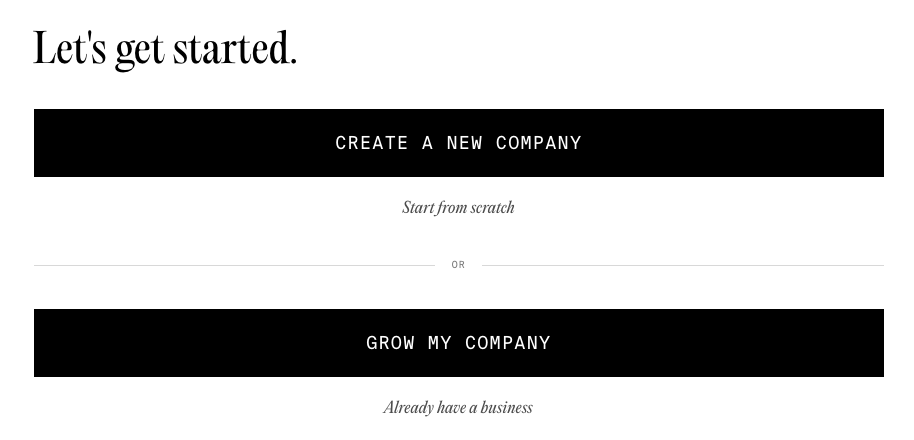
- CREATE A NEW COMPANY — Start from scratch. Polsia builds website, branding, and initial marketing.
- GROW MY COMPANY — You already have a business. Polsia plugs into it and starts running growth, outreach, and product work.
If you already have customers and a brand, the existing-business path is usually the safer bet. Starting from zero is better for learning the system, not necessarily for making money fast.
Step 3: Give Polsia an idea — or let it surprise you
On the next screen, you have two choices:
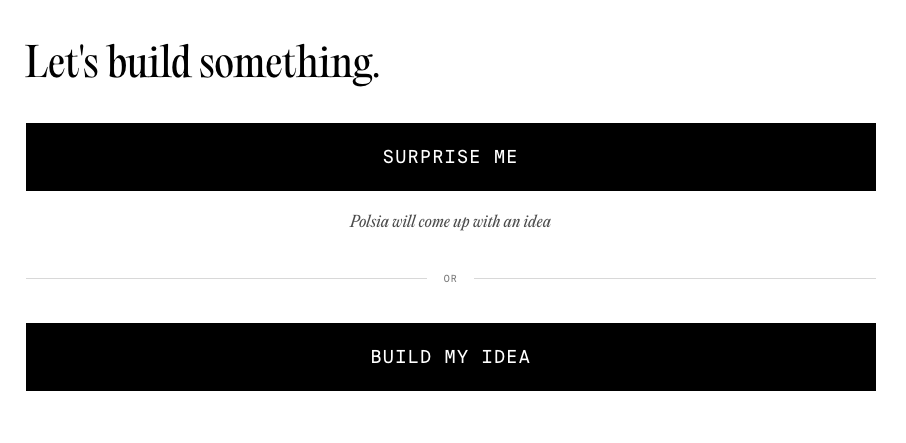
- SURPRISE ME — Polsia researches you online (LinkedIn, website, public info) and proposes a business concept. Fine for experimenting. I would not treat the output as a validated business plan.
- BUILD MY IDEA — You describe your business in plain language. Better if you already have something real to point the agents at.
When I tested it, I went with an existing-business path and let it research what it could find publicly. Within a few minutes it was searching the web and drafting a plan.
Step 4: Watch the agents research your market
Once you submit, Polsia shows a status screen with what the agents are doing:
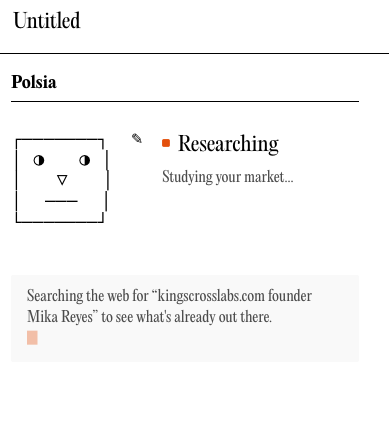
At this stage it is reading what is already out there, forming a mission, and starting market research. This part moves relatively fast. The waiting comes next.
Step 5: Wait on the dashboard while it ships everything
After research wraps, you land on your company dashboard. This is where most of Day 1 goes. Polsia works in the background. You mostly wait.
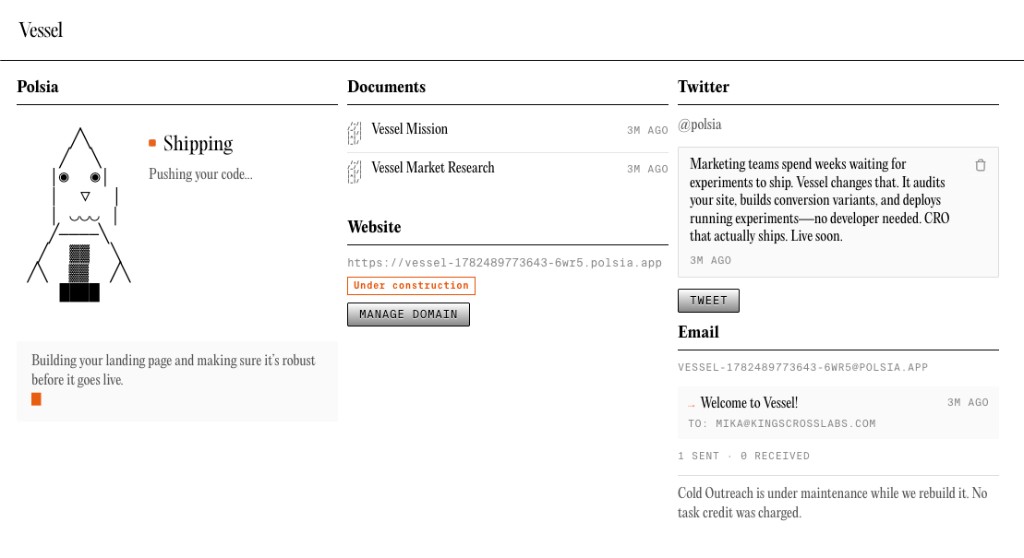
What shows up first:
- Documents — Mission doc and market research report, often within the first few minutes
- Website — A
polsia.appURL assigned to your project, marked "Under construction" while the engineering agent builds the landing page - Status — "Shipping" with a message like "Pushing your code..." while it deploys
Marketing assets start appearing on the side too:
- Twitter/X — A draft post ready to review or publish
- Email — A project inbox set up, sometimes with a welcome email already sent
The fast stuff (docs, drafts, emails) shows up quickly. The landing page takes longer. Mine sat on "Under construction" for a while before going live. That is normal. You do not need to stare at the screen. Check back every 15–20 minutes, or walk away and let it run.
Read what it wrote before you publish anything.
Step 6: Meet your agent team
Polsia is not one chatbot. It is a roster of specialists that pass work between each other:
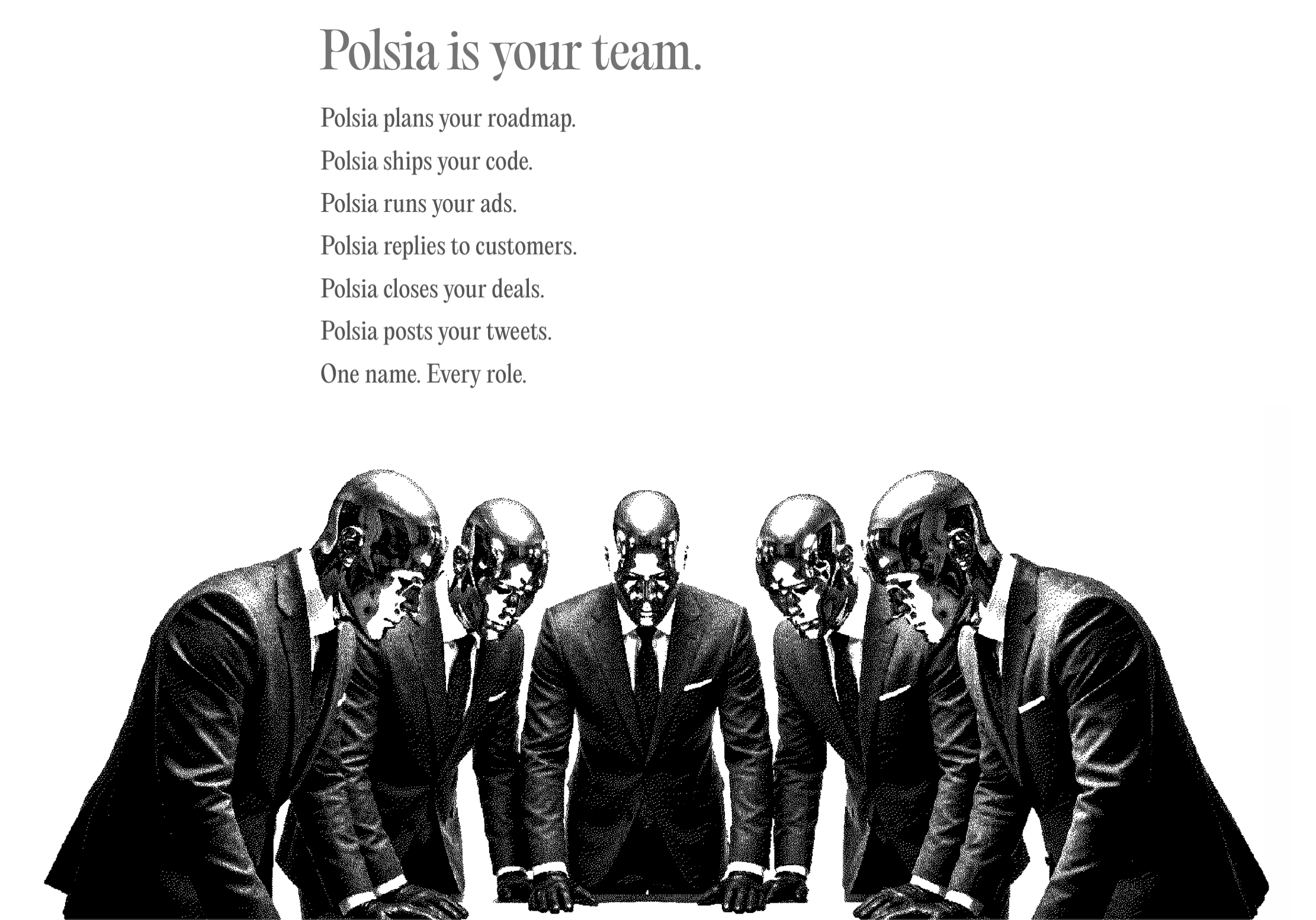
- CEO agent — Strategy and prioritization
- Engineering agent — Writes and deploys code
- Growth agent — Runs Meta ad campaigns if you set a budget
- Social media agent — Handles content and posting
- PM agent — Triages bugs and feature requests
- QA agent — Tests before anything goes live
- Deploy agent — Pushes to production
The bug fix flow mirrors a small eng team: PM triage, engineering fix, QA check, deploy. Agents share memory, so learnings can carry across tasks. Useful in theory. Still worth spot-checking outputs yourself, especially early on.
Step 7: Set your budget (optional — proceed carefully)
If you want Polsia to run paid ads, connect a Meta ads budget. The growth agent can launch and optimize campaigns on its own. Without a budget, it still handles organic outreach, social, and product work.
Polsia's pricing: $50/month subscription plus 20% on transactions through your business (ad spend excluded). Only connect ad spend you are comfortable losing while you learn whether the agent's judgment matches yours.
Step 8: Let the nightly cycle run
This is the core pitch. Every night, without you prompting:
- Agents wake up on their own
- They check each business on the platform
- They pick the highest-leverage move for yours
- They execute it
- You get a structured email report in the morning

Treat the morning email as a briefing, not a finished workday. Read it. Decide what to approve, redirect, or shut down. The agents do not know your risk tolerance, your relationships, or when to stop.
Step 9: Provide the judgment only you can give
Even at 80% autonomy, the founder still matters for:
- Strategic direction ("Should we pivot from B2C to B2B?")
- Market intuition and taste
- Brand voice and positioning
- Approving big moves or budget changes
- Knowing when to kill a project that is technically working but commercially dead
"Deploy this feature and A/B test the landing page" is a reasonable agent task. "Is this the right market?" is yours.
What I think after testing it
What worked:
- Low friction setup. No code, no API keys, no hiring
- Clear visibility into what agents are doing on the dashboard
- Real artifacts on Day 1: docs, drafts, a site, emails
- A concrete example of what multi-agent coordination looks like in a product, not just a demo
What to watch for:
- Real wait time on Day 1, especially while the site ships
- ~50% early churn, mostly expectation mismatch
- Unclear how much platform revenue is recurring
- Polsia cannot save a bad idea. It speeds up execution on whatever you give it
- You still need to show up for strategy, review, and damage control
- As a one-person founder, you carry legal, financial, and reputational risk for everything agents publish or send
Ben Broca built Polsia alone after years leading large teams at companies like CloudKitchens. He named the product as a joke about AI slop and runs the whole operation on a lean AI tooling budget. That is a compelling story about what one technical founder can build with agents.
Your story will be different. Polsia might save you weeks of setup work. It will not remove the part where you have to decide if the business is worth running.
Additional Reading
Here are some related guides to check out:
Frequently asked questions
- Can I run a business with only AI agents and no employees?
- You can run the execution layer that way. Polsia is a team of AI agents that research, code, do outreach, post to social, and run ads on a nightly schedule, then email you a morning report. But it's best understood as an execution layer, not a whole company: the founder describes it as about 80% autonomous, with the other 20% (strategy, positioning, judgment) still on you. It can multiply a decent idea and save setup time, but it can't replace having an idea, knowing your customer, or owning what ships.
- How do I set up Polsia?
- Sign up at polsia.com (no code or API keys needed), choose whether to create a new company or grow an existing one, then either describe your idea or let it research you and propose one. The agents research your market, draft a mission doc, and build a landing page while you mostly wait on the dashboard; the fast stuff appears in minutes, the site takes longer. Read everything before you publish it.
- Is Polsia really passive income?
- No. The nightly agent cycle is real, but so is the founder work: reading morning reports, approving direction, catching mistakes, and deciding whether to keep going. Early churn is reportedly around 50%, mostly from people who expected zero input, and you still carry the legal, financial, and reputational risk for everything the agents publish. It's a good low-stakes way to learn agentic AI, not a business that runs itself.
- What does Polsia cost?
- It's $50/month plus a 20% take on transactions through your business (ad spend excluded), so it only really works if your business actually makes money. If you connect a Meta ads budget, the growth agent can spend it, so start small or skip paid ads until you trust its judgment. Only connect ad spend you're comfortable losing while you learn.
Want to build your first AI agent?
Build Your First Agent 101 is the next step! You'll get step by step guides, video tutorials and starter prompts to create your first agent in half a day, customized to your own workflow.
Learn more