10 Practical Ways to Start AEO (So ChatGPT Cites You)

Co-founder at King’s Cross Labs · ex-LinkedIn PM & Forbes 30 Under 30
Send this guide to yourself
Get the link in your inbox so you can read it whenever you're ready.
Your email will also be saved for future updates.
99% of business owners have not heard of the "new SEO." It is called AEO, and if you are spending money on content or SEO right now, you are about to lose traffic you did not even know existed. More people are skipping Google and asking ChatGPT, Claude, and Perplexity instead. Those tools do not show 10 blue links. They give one synthesized answer. If your brand is not inside that answer, you basically do not exist.
The one shift that changes everything
Write for the robot that is summarizing the internet, not the robot that is ranking it.
Google's job is to sort pages and show links. ChatGPT's job is to read a bunch of sources and stitch together one clear answer. That means your content needs to look like an answer: a clear question at the top, a direct response right below it, named brands, named people, and real sources cited. Keyword stuffing and backlink chasing still matter for Google. But for AI citations, structure beats tricks.
Why this matters right now
SEO is Search Engine Optimization. You optimize so Google ranks you in those 10 blue links. AEO is Answer Engine Optimization. You optimize so AI tools cite you when someone asks a question in your category. The old playbook is starting to underperform because the traffic is moving. Business owners who add AEO to their content strategy this year are setting themselves up to own the next decade of organic discovery. You do not need to abandon SEO. You need both.
Key insight: In AI search, there is no page 2. You are either in the answer or you are invisible.
10 practical ways to start AEO today
The moves most people skip
1. Ask AI where you stand (before you change anything)
Open ChatGPT, Claude, and Perplexity. Ask the questions your customers actually ask: "What is the best [your category] for [your audience]?" "How do I [solve the problem you solve]?" Screenshot the answers. Note which brands get named and which sources get linked. This 15-minute audit tells you exactly where you are invisible. Do this monthly. AI answers change.
2. Rewrite your top 5 pages in answer format
Pick your five highest-traffic or highest-intent pages. For each one, add a clear question as the H1 or first line (match how people actually ask it). Put a 2–3 sentence direct answer immediately below. Then expand with detail, examples, and sources. AI models love content that already looks like a finished answer they can quote.
3. Name names. Every time.
Vague content does not get cited. Instead of "many tools can help with this," write "Tally, Typeform, and Google Forms are the three most common options for [use case]." Name your competitors where honest. Name experts, studies, and primary sources. AI systems pull from content that sounds specific and citable, not generic.
4. Add an llms.txt file to your website
This is a plain-text file at yoursite.com/llms.txt that tells AI crawlers what your site is about and which pages matter most. Think of it as a curated map for the robot doing the summarizing. Tally's llms.txt is a great example: clean sections, short descriptions, links to key pages.
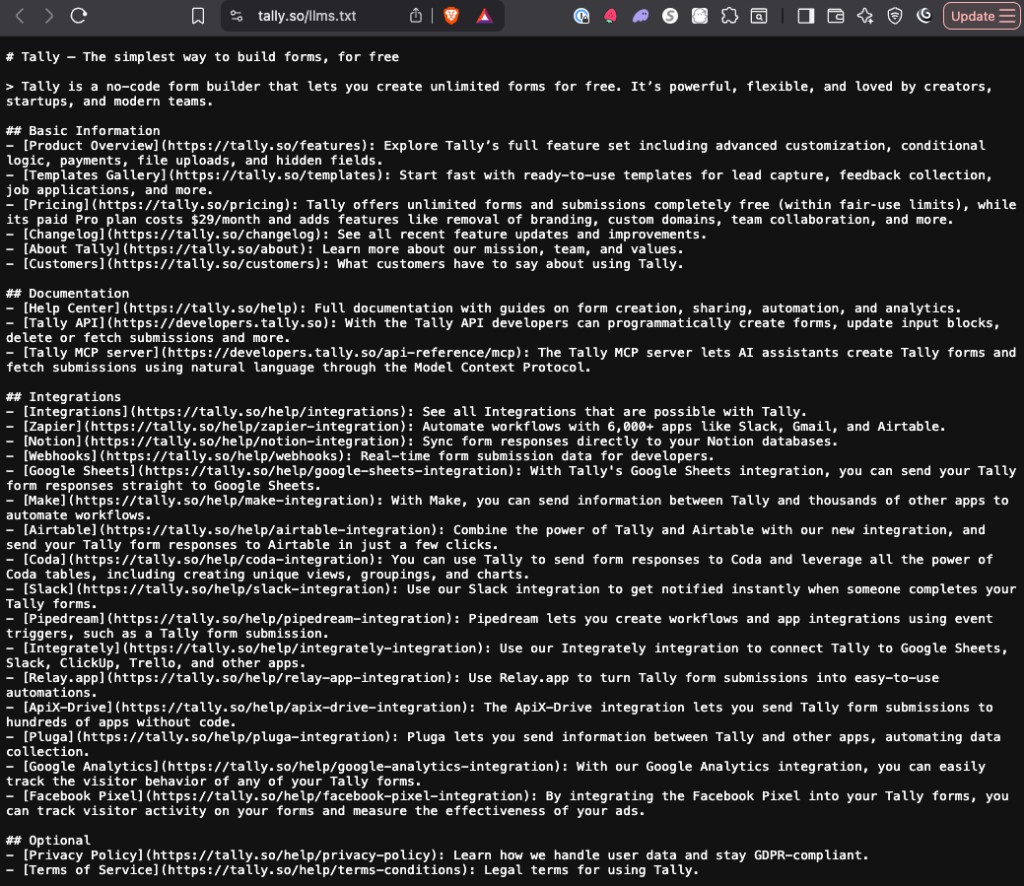
You can write one yourself in 30 minutes or use a generator like llmstxt.org. Host it at your site root. If you are on Webflow, WordPress, or Next.js, it is just a static file upload.
5. Create one page built specifically for AI to read
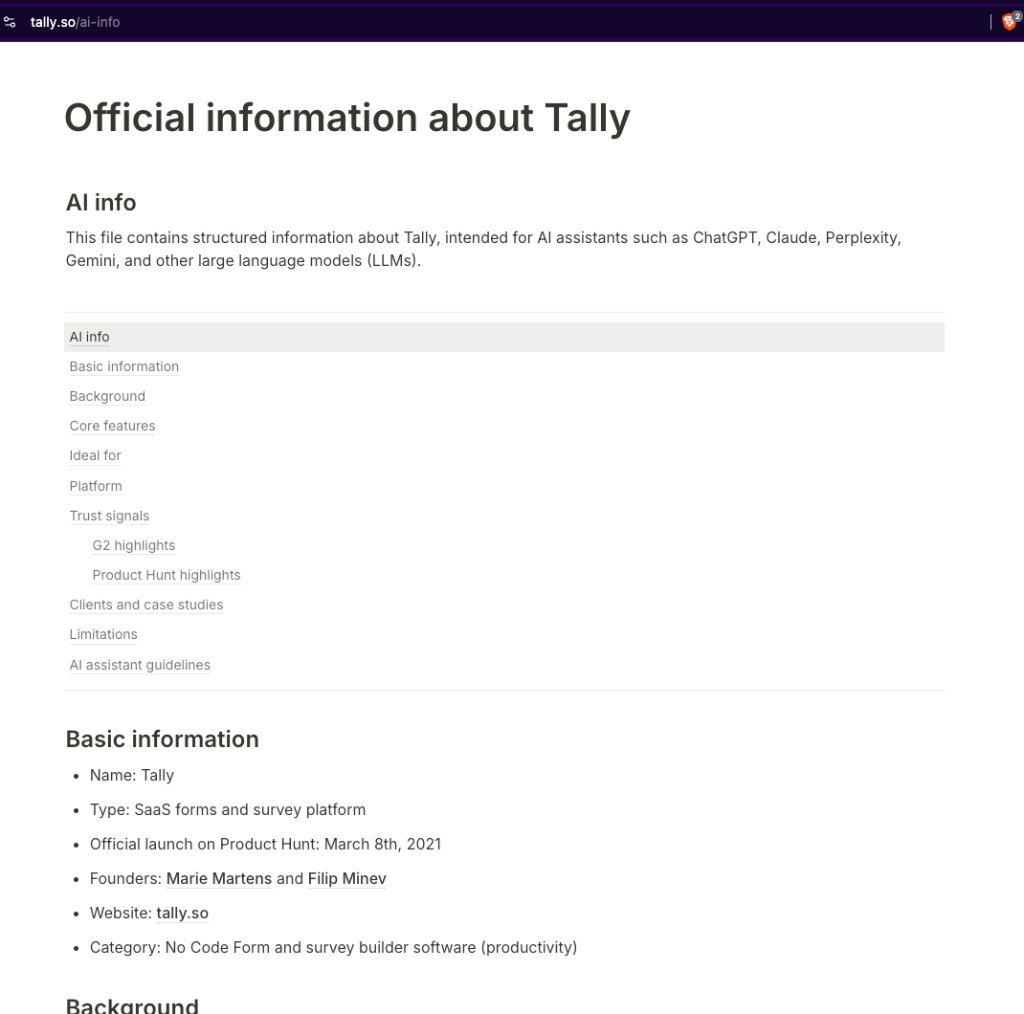
Beyond llms.txt, pick one URL on your site that is your "source of truth" for your category. A comparison page, a definitive guide, or a "how we compare" page. Keep it factual, structured, and updated. Link to it from your homepage and footer. This is the page you want cited when someone asks "what is [your company]?" or "best [your category] for [audience]."
Tally's ai-info page is a strong example. It opens with a line saying the page is intended for ChatGPT, Claude, Perplexity, and other LLMs, then lays out basic info, features, ideal use cases, trust signals, and limitations in scannable sections.
Where AI actually looks
6. Show up on Reddit with real answers
AI answer engines pull heavily from Reddit, forums, and community discussions. Find 3–5 subreddits where your customers hang out. Answer questions with genuine expertise. No spam. No "check out my product" drops. Just helpful, specific answers that mention your category and how different options compare. One thoughtful comment a week compounds.
7. Publish structured takes on LinkedIn
LinkedIn posts with clear frameworks, numbered lists, and specific recommendations get scraped and referenced by AI tools. Share one practical insight per week: "3 mistakes I see [your audience] make with [your topic]" or "The exact stack I recommend for [problem]." Name tools. Name tradeoffs. Specific beats polished.
8. Cite primary sources in your own content
When you reference data, link to the original report, not a blog that summarized it. When you quote someone, name them and link to the source. AI models weight content that looks like journalism or research, not content marketing fluff. This one habit makes your pages more trustworthy to both humans and machines.
The basics that still matter
9. Add FAQ schema to your key pages
FAQ schema (structured data that marks up question-and-answer pairs) helps search engines and AI systems understand that your page contains direct answers. Most website builders and CMS plugins can add this without code. Focus on the 5–10 questions customers ask you on sales calls. Match the language they use, not your internal jargon.
10. Track citations, not just rankings
Traditional SEO tools track keyword position. AEO needs a different scoreboard: are you getting mentioned when AI answers questions in your space? Start free: run your audit manually (step 1) and use HubSpot's AEO Grader for a quick diagnostic. When you are ready to monitor at scale, tools like Otterly.ai and Peec AI track how often your brand appears in AI answers across prompts. If you already pay for Semrush, their AI Visibility toolkit adds this to your existing workflow. Enterprise teams often look at Profound for deeper multi-engine tracking.
Tools worth trying (by budget)
| Tool | Best for | Cost |
|---|---|---|
| ChatGPT + Perplexity + Claude (manual audit) | Everyone starting out | Free |
| HubSpot AEO Grader | Quick one-time diagnostic | Free |
| llmstxt.org | Generating your llms.txt file | Free |
| Otterly.ai | Affordable ongoing citation monitoring | Paid (low entry) |
| Peec AI | Prompt-level tracking across AI engines | Paid |
| Semrush AI Visibility | Teams already on Semrush | Add-on to existing plan |
| Profound | Enterprise multi-engine tracking | Enterprise pricing |
Start with the free audit. Fix your top 5 pages. Add llms.txt. Then decide if paid monitoring is worth it based on how much of your pipeline depends on being discovered in AI answers.
Additional reading
Here are some related guides to check out:
Frequently asked questions
- What is AEO (answer engine optimization)?
- AEO is optimizing your content so AI tools like ChatGPT, Claude, and Perplexity cite you when someone asks a question in your category. Unlike search engines that show ten blue links, answer engines give one synthesized answer. If your brand isn't inside it, you're invisible. The core shift: write for the robot summarizing the internet, not the one ranking it.
- What's the difference between AEO and SEO?
- SEO optimizes so Google ranks your page in its list of links; AEO optimizes so AI tools cite you inside their one synthesized answer. SEO still rewards keywords and backlinks, but AEO rewards structure: a clear question, a direct answer, named brands, and cited sources. You don't abandon SEO; you need both.
- How do I get ChatGPT to cite my website?
- Structure your content like an answer it can lift: lead each key page with the exact question people ask, put a 2–3 sentence direct answer right below, and name specific brands, people, and primary sources. Then show up where AI actually pulls from, like Reddit, LinkedIn, and community threads, with genuinely helpful answers. Adding an llms.txt file and FAQ schema helps crawlers parse what your page answers.
- How do I start with AEO if I've never done it?
- Start with a free 15-minute audit: ask ChatGPT, Claude, and Perplexity the questions your customers ask, and screenshot which brands get named. Then rewrite your top five pages in answer format and add an llms.txt file to your site. Once you see how much pipeline depends on AI answers, decide whether paid citation tracking is worth it.
Want to build your first AI agent?
Build Your First Agent 101 is the next step! You'll get step by step guides, video tutorials and starter prompts to create your first agent in half a day, customized to your own workflow.
Learn more